
Xps Insulation for Roof
XPS insulation is a robust, moisture-resistant material that delivers exceptional thermal performance for roofs, aiding in the reduction of energy costs throughout the year. Its closed-cell structure prevents water absorption and resists freeze-thaw damage, making it ideal for challenging climates.
With a high compressive strength, XPS can support substantial loads and mechanical fasteners, ensuring reliability in various roofing applications. It integrates seamlessly with numerous roofing systems and adheres to fire safety regulations.
To understand how XPS can enhance the durability of your roof, continue exploring its versatile advantages.
Superior Thermal Performance and Energy Savings
XPS insulation is renowned for its exceptional thermal performance, making it a favoured option for roof insulation. With a high initial R-value, it effectively resists heat flow better than many alternative insulations, ensuring that buildings remain warmer in winter and cooler in summer. This capability allows for the use of thinner layers of insulation, which is particularly advantageous in spaces where height is a concern. Furthermore, XPS demonstrates impressive performance in colder climates, with its thermal resistance increasing at lower temperatures. Research indicates XPS maintains its R-value over time better than EPS, especially when exposed to moisture, resulting in reduced heating and cooling expenses by minimising heat transfer through the roof. The superior thermal barrier not only enhances comfort within the building but also alleviates the workload on heating, ventilation, and air conditioning (HVAC) systems.
Outstanding Moisture Resistance and Longevity
Building on its reputation for superior thermal performance, XPS insulation also provides exceptional moisture resistance and durability. Its closed-cell structure prevents water absorption, maintaining moisture content significantly lower than alternative options. This design functions as a semi-permeable vapour retarder, effectively safeguarding the building against mould, mildew, and decay. The closed-cell structure also enhances its resistance to water vapor transmission, XPS insulation retains its dimensional stability and structural integrity even in wet conditions and fluctuating temperatures, ensuring a lifespan that can extend for decades with minimal performance degradation. Its high resistance to freeze-thaw cycles makes it particularly suitable for harsh climates.
Effectively resists moisture damage in below-ground applications such as foundations
Ideal for inverted and flat roofs that are exposed to the elements
Preserves thermal resistance (R-value) even when subjected to moisture
Contributes to long-term energy efficiency and overall building health
Mechanical Strength for Load-Bearing Applications
High compressive strength is crucial for XPS insulation to effectively support substantial loads without undergoing deformation, rendering it ideal for load-bearing applications. This characteristic guarantees long-term stability, particularly under the pressures exerted by equipment, vehicles, or structural weight. Carefully selected XPS boards offer dependable load resistance and durability, making them suitable for roofing systems. Moreover, XPS boards such as SOPRA XPS 500 and SOPRA XPS 700 have proven performance under high compression, ensuring reliable support in demanding environments.
High Compressive Strength
Compressive strength measures a material's ability to endure loads that cause it to be squeezed or compressed. XPS insulation boards typically offer strengths suitable for general applications, ensuring reliable performance. The higher the compressive strength, the more weight the material can support without failure. High-performance XPS can support significant pressures with minimal deformation, making it an ideal choice for demanding environments. For instance, certain XPS grades can provide enhanced strength, catering to a variety of needs across construction and insulation projects. Key features include:
Constructed from closed-cell extruded polystyrene foam, ensuring durability
Resistant to deformation under sustained or fluctuating loads
Maintains strength more effectively than brittle foams
Exhibits elastic deformation, with minimal permanent set
This impressive compressive strength guarantees that XPS can support roofing systems, various equipment, and foot traffic without compromising its structural integrity.
Load-Bearing Capacity
XPS insulation boards are engineered to not only fulfil their insulating roles but also to mechanically endure the loads placed on rooftops. They effectively distribute weight evenly, which helps to prevent any localized damage. When shielded with appropriate layers, these boards resist surface dents caused by foot traffic or equipment, thereby maintaining both their structural integrity and thermal performance. Their impact resistance provides a cushion against accidental damage during installation and routine maintenance. This durability under transient loads, such as wind or foot traffic, makes them particularly suitable for rooftops that support heavy equipment or experience frequent usage.
Load Type |
XPS Performance |
| Load distribution | Evenly spreads weight, reducing damage |
| Impact resistance | Protects against handling and installation |
| Moisture exposure | Retains strength in wet conditions |
| Cold weather effects | Resists damage from freeze-thaw cycles |
| Structural applications | Ideal for heavy-duty rooftop uses |
XPS insulation boards stand out for their resilience in challenging conditions, ensuring long-lasting performance for various rooftop applications. The combination of their load-bearing capacity and insulating properties makes them an excellent choice for any roofing project, providing both functionality and reliability.
Long-Term Structural Stability
Long-term structural stability is an essential characteristic that makes XPS insulation a dependable choice for load-bearing applications on rooftops. Its rigid, closed-cell structure effectively resists moisture and temperature fluctuations, preventing shrinkage or expansion that could compromise the roof's integrity. The foam retains its shape and size over time, thanks to its excellent dimensional stability.
Moreover, ageing tests demonstrate that XPS maintains its compressive strength and resists creep under load, ensuring consistent performance. Its high-density, robust core effectively withstands mechanical wear and prevents deformation, even with regular maintenance.
Maintains shape and size despite environmental changes
Resists moisture intrusion, safeguarding material integrity
Retains compressive strength over time, with minimal creep
Consistently supports mechanical fasteners and roof loads
Versatile Installation Options and Design Flexibility
Installing roof insulation with XPS boards provides a variety of options that can be customised to suit the specific requirements of different projects. Numerous installation techniques allow for single or multi-layer configurations, enhancing insulation thickness and overall coverage.
The boards are tightly butted with staggered joints to minimise thermal bridging and ensure continuous insulation throughout the roof. These boards can be firmly pressed onto prepared surfaces, accommodating openings and penetrations with ease.
Depending on the particulars of the project, mechanical fasteners with sealing washers or adhesives may be employed to secure the boards in place. Utilising larger boards reduces the number of joints, which streamlines the installation process, while precise cuts enable fitting around roof features such as vents and chimneys.
The layout of the insulation can be adjusted to accommodate various roof shapes, including flat, sloped, or more intricate designs. This design flexibility makes XPS insulation a versatile and effective choice for a wide range of roofing projects, ensuring that the insulation meets both performance and aesthetic demands. Additionally, the manufactured through an extrusion process resulting in a closed-cell structure, which enhances durability and moisture resistance over other insulation types.
Fire Safety and Code Compliance Features
Fire safety is a crucial consideration when selecting insulation materials for roofing projects. Extruded polystyrene (XPS) insulation boasts a dense, closed-cell structure that helps to slow down combustion and produces less smoke and toxic gases compared to other foam alternatives. Its density and structure make XPS inherently fire resistant. Nevertheless, it remains combustible and must be handled with care in areas susceptible to fire hazards. To adhere to safety regulations, XPS insulation must comply with fire codes that ensure its suitability for exposed interior applications. Its fire performance includes: - Adhering to flame spread and smoke development limits as outlined in relevant standards - Upholding fire resistance ratings in wall assemblies in accordance with building regulations - Being certified for use in fire-rated wall systems - Providing moisture resistance that supports long-term fire safety These attributes contribute to the protection of buildings and their occupants, particularly in roofing applications where fire safety is paramount.
Sustainability Initiatives and Long-Term Warranties
Sustainability initiatives are playing an increasingly vital role in the selection of XPS insulation for roofing projects in the UK. Many manufacturers are now adopting eco-friendly processes, such as climate-conscious CO2 technology, which replaces harmful blowing agents like HFCs, thereby reducing the carbon footprint associated with production. Understanding XPS Properties and Technical Advantages In addition, eco-friendly production methods can lead to improved energy efficiency during manufacturing, further enhancing the overall sustainability profile of the product. Incorporating recycled materials is common practice, supporting a circular economy by reintegrating waste materials into new insulation boards. The durability and long lifespan of XPS insulation mean that replacements are less frequent, which not only reduces waste but also conserves valuable resources. XPS insulation is renowned for its high thermal resistance, which enhances energy efficiency and subsequently lowers heating and cooling demands. Its moisture resistance is another key benefit, helping to maintain a healthy indoor environment. Moreover, XPS boards are fully recyclable after use, allowing for multiple reuse cycles, further promoting sustainability. Eco-certifications such as BREEAM recognise XPS as a responsible choice, aligning with conscientious building practices that prioritise environmental stewardship. As sustainability becomes increasingly essential in construction, XPS insulation stands out as a practical solution that supports both performance and environmental goals.
Compatibility With Various Roofing Systems
XPS insulation is compatible with a broad range of roofing systems, making it a versatile option for numerous projects. Its capacity to integrate effortlessly with various materials and roofing designs ensures consistent performance and long-lasting durability. Applications of SOPRA XPS Insulation such as green roofs and inverted roof systems demonstrate its adaptability across different project types. Furthermore, the flexible installation methods facilitate efficient assembly across flat roofs, inverted systems, and metal roofing, supporting smooth and reliable construction. With its excellent thermal efficiency and moisture resistance, XPS insulation is an ideal choice for enhancing the overall performance of your roofing system. This adaptability not only contributes to energy savings but also prolongs the lifespan of the roof, making it a prudent investment for any building project. Whether you're working on a new build or a refurbishment, XPS insulation provides the reliability and compatibility needed to meet the demands of modern roofing applications. Its ease of use and effectiveness make it a preferred option among architects and builders alike.
Versatile Roof Compatibility
Foamular XPS insulation is exceptionally versatile and compatible with a diverse array of roofing systems, making it a preferred choice for numerous building projects across the UK.
It performs admirably under single-ply membranes such as EPDM, TPO, and PVC, owing to its stable thermal and moisture-resistant properties. The tapered XPS facilitates positive drainage slopes, ensuring that water flows off the roof efficiently and mitigates the risk of ponding.
Additionally, it integrates seamlessly with mechanically attached or adhered membranes without compromising the integrity of the system. In protected membrane roofs and vegetative systems, XPS’s durability and low water absorption make it a dependable option when adequately shielded.
Ideal for roof recovery installations
Creates precise slopes for effective drainage
Supports soil loads in green roofs
Compatible with various membrane types when properly sealed
With its robust performance and adaptability, Foamular XPS insulation stands out as an excellent choice for roofing applications, delivering long-lasting results and enhanced energy efficiency.
Seamless System Integration
The ability of XPS insulation to integrate seamlessly with various roofing systems is a key factor in its popularity among builders and architects.
XPS supports protected membrane roof assemblies without compromising performance due to its high compressive strength. It effectively resists moisture and freeze-thaw cycles, helping to maintain thermal efficiency.
XPS integrates well with liquid-applied roofing and waterproofing systems, thanks to its low water absorption and custom sizing options. It also works harmoniously with continuous insulation and structural sub-framing systems, ensuring a smooth, energy-efficient installation.
Furthermore, XPS is compatible with External Insulation and Finishing Systems (EIFS) and drainage layers, providing essential moisture protection while supporting energy-efficient designs.
Its durability enables it to withstand the weight and stresses associated with ballasted and green roof systems, making XPS a highly versatile choice for roof system integration.
Adaptable Installation Methods
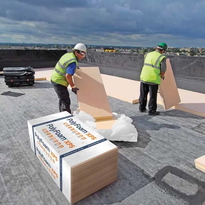
Installing XPS insulation over various roofing systems necessitates careful consideration of compatibility and the appropriate techniques. It can be effectively used with multiple substrates, including plywood, OSB, and metal roofs.
To ensure a successful installation, several key steps are essential:
Utilise maximum board sizes to minimise joints, which aids in preventing thermal bridging.
Align joints accurately and stagger edges across layers for enhanced stability and thermal performance.
Secure the insulation with long, exterior-grade screws through the insulation into the roof framing, particularly over existing roofs.
Install protective layers such as membrane or coverboard promptly after insulation to safeguard the system.
This adaptability allows XPS to integrate seamlessly with various roofing types, whether employing fully adhered methods or mechanical fastenings.
Proper installation ensures energy efficiency, durability, and a watertight roofing system, fostering a sense of confidence and belonging among roofing professionals and property owners alike.
Benefits for Commercial and Residential Roofs
XPS insulation provides numerous advantages for both commercial and residential roofing applications, making it a preferred option for builders and homeowners alike.
Its exceptional thermal resistance aids in lowering heating and cooling expenses while ensuring stable indoor temperatures. Unlike conventional insulation, XPS maintains its thermal performance even when subjected to moisture or the effects of freeze-thaw cycles, ensuring reliable insulation over time.
The waterproof characteristics of XPS inhibit the growth of mould and prevent rot, making it particularly suitable for damp conditions. Furthermore, this insulation material boasts impressive durability and structural integrity, effectively resisting compression and heavy loads, which is ideal for rooftop terraces or areas experiencing frequent foot traffic.
XPS insulation is versatile, compatible with various roofing styles, including flat, pitched, or green roofs. This adaptability contributes to enhanced energy efficiency and promotes long-term sustainability in building projects.
Conclusion
XPS insulation provides significant advantages for roofing applications, including exceptional thermal performance, moisture resistance, and robust mechanical strength. Its adaptable installation methods and adherence to safety standards make it ideal for both commercial and residential roofing projects.
Furthermore, XPS insulation boasts sustainability features and offers long-term warranties, presenting cost-effective and durable solutions. Overall, it enhances energy efficiency and prolongs the lifespan of roofs, establishing itself as a dependable option for a variety of roofing requirements.