

Foam pipe insulation serves as a critical thermal barrier in UK residential and commercial infrastructure, primarily used for energy conservation, frost protection, and condensation control. Polyethylene foam remains the standard for domestic plumbing due to its cost-effectiveness, while nitrile rubber is preferred for HVAC and refrigeration systems because of its superior moisture resistance. The industry has recently transitioned to the BS 5422:2023 standard, which mandates increased insulation thicknesses to meet carbon reduction goals. Fire safety classifications have also shifted from the national Class 0 to the European Euroclass system, with a focus on smoke emission (s) and flaming droplet (d) ratings. Proper installation, specifically the sealing of joints and the use of mitred cuts at corners, is required to prevent significant thermal bypass.
The Evolution and Functionality of Thermal Lagging in UK Building Services
The thermal insulation of pipework, commonly referred to as pipe lagging in the United Kingdom, represents a fundamental component of building services engineering and domestic maintenance. The primary objective of these materials is to provide a thermal barrier that reduces the transfer of heat between the fluid inside a pipe and the surrounding environment. Within the specific climatic context of the British Isles, where winter temperatures frequently fall below zero and high relative humidity is common, this barrier serves three distinct but equally vital purposes: the conservation of energy in heated systems, the prevention of freezing in cold water systems, and the control of condensation on chilled surfaces.
Energy conservation is driven by the need to maintain the temperature of hot water as it travels from a boiler or heat pump to its final destination, such as a radiator, tap, or shower. Without adequate insulation, significant thermal energy is dissipated into unheated areas like lofts, basements, or floor voids, forcing the heat source to operate more frequently and increasing operational costs. In the current economic climate, where energy prices remain a significant concern for UK households, the reduction of heat loss through pipework is one of the most cost-effective methods of improving property efficiency.
Frost protection is a major concern for pipes located in unheated or exposed areas, such as lofts, garages, and external walls. When water freezes, it expands, creating internal pressure that can lead to catastrophic pipe bursts. The cost of repairing such damage in the UK can be substantial, with average insurance claims for burst pipes often exceeding twelve thousand pounds. Foam insulation retards the freezing process by trapping air, which has low thermal conductivity, around the pipe, maintaining the water temperature above the freezing point for longer periods during cold snaps.
Condensation control is particularly relevant for cold water and chilled systems. When the surface temperature of a pipe falls below the dew point of the ambient air, moisture condenses on the pipe. This phenomenon, often called pipe sweating, can lead to dampness, structural rot, and the growth of mould, which poses a health risk to occupants. High-quality closed-cell foam insulation prevents the warm, moist air from reaching the cold pipe surface, thereby eliminating the risk of condensation.
Material Science of Flexible Polyethylene Foam
Polyethylene (PE) foam is the most prevalent insulation material used in the UK domestic market. It is a flexible, closed-cell material manufactured through the expansion of polyethylene resin. The closed-cell structure is a defining characteristic, as it ensures that the individual cells of the foam are not interconnected, preventing the passage of water and air through the material.
This material is available in two primary forms: chemically cross-linked and physically cross-linked PE foam. Cross-linking is a chemical process that bonds the polymer chains together, resulting in a more robust and heat-resistant material. Physically cross-linked foam often has a smoother surface and a more uniform cell structure, which can improve its thermal performance and aesthetic appearance when installed in visible areas.
The thermal conductivity of polyethylene foam, often denoted as the Lambda value, typically ranges between 0.034 and 0.040 W/mK. This efficiency allows it to be used in relatively thin sections while still providing adequate protection for domestic heating systems. PE foam is also valued for its wide service temperature range, typically operating effectively from -45 degrees Celsius to +105 degrees Celsius, making it suitable for both cold water mains and central heating flow pipes.
One significant advantage of polyethylene is its environmental profile. Unlike some synthetic rubber alternatives, polyethylene is largely recyclable, which aligns with the increasing focus on sustainability in the UK construction industry. Brands like Climaflex and Tubolit are common examples found in UK DIY stores and trade counters. These products are often supplied in one-metre or two-metre lengths with a pre-cut longitudinal slit, allowing for easy installation over existing pipework.
Technical Analysis of Nitrile Rubber and Elastomeric Foams![]()
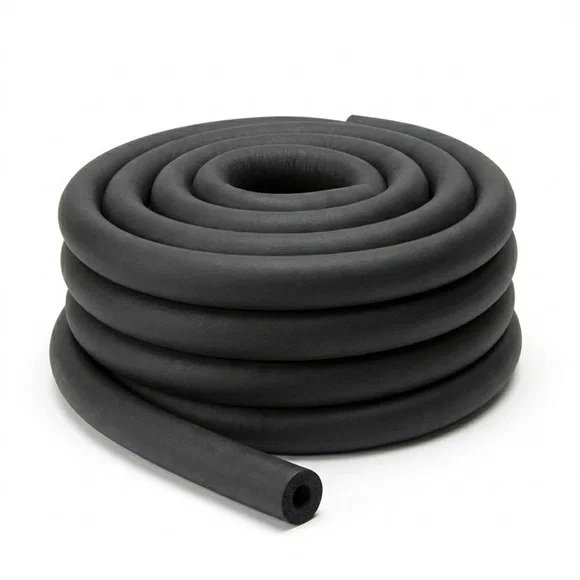
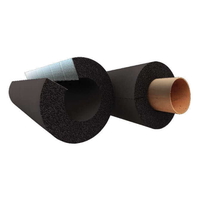
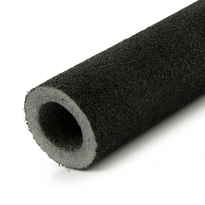
Nitrile rubber, technically classified as Flexible Elastomeric Foam (FEF), is a synthetic rubber compound used primarily in professional HVAC and refrigeration applications. While polyethylene is the standard for general plumbing, nitrile rubber is the material of choice when higher levels of moisture resistance and flexibility are required.
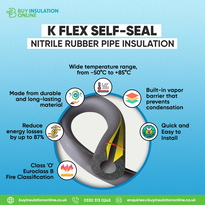
The defining characteristic of nitrile rubber is its exceptionally high resistance to water vapour. The material possesses a high mu-value (water vapour diffusion resistance factor), which means it acts as an inherent vapour barrier. This is critical for chilled water and air conditioning systems, where any moisture ingress would lead to saturation of the insulation and a total loss of thermal efficiency. Wet insulation can conduct heat up to twenty times faster than dry insulation, making the vapour-proof nature of nitrile rubber indispensable in cooling applications.
Nitrile rubber is also more flexible than polyethylene, allowing it to be easily manipulated around complex fittings and tight bends without the need for extensive cutting. This flexibility also makes it more resistant to mechanical damage and compression. In high-traffic areas or plant rooms where pipes may be subject to occasional impact, nitrile rubber maintains its thickness and insulating properties better than more rigid foams.
In terms of thermal performance, nitrile rubber often provides a slightly lower (better) thermal conductivity than PE foam, with values typically around 0.033 to 0.036 W/mK. It also performs well across a similar temperature range, though specialised versions are available for high-temperature solar thermal applications. However, nitrile rubber is generally more expensive than polyethylene and is not as easily recycled.
| Feature | Polyethylene (PE) Foam | Nitrile Rubber (FEF) |
| Core Structure | Closed-cell Polyethylene | Closed-cell Elastomeric |
| Standard Thermal Conductivity | 0.034 - 0.040 W/mK | 0.033 - 0.036 W/mK |
| Moisture Vapour Resistance | Moderate | Very High |
| Typical UK Brands | Climaflex, Tubolit | Armaflex, K-Flex |
| Primary Use Case | Domestic Heating/Plumbing | HVAC/Refrigeration |
| Flexibility | Moderate | High |
| UV Resistance | Low (Requires protection) | Moderate (Requires protection) |
High-Performance Materials: Phenolic Foam and EPDM
Beyond the common flexible foams, two other materials play specialized roles in the UK insulation market: Phenolic foam and EPDM rubber.
Phenolic foam is a rigid, closed-cell thermoset insulation known for its extreme thermal efficiency. It offers one of the lowest thermal conductivities of any mass-produced insulation material, with values frequently as low as 0.025 W/mK. This allows for much thinner insulation sections to be used while achieving the same level of heat loss prevention as thicker PE or rubber materials. This is particularly beneficial in modern UK construction, where space in service risers and ceiling voids is often extremely limited. Phenolic foam is also naturally fire-resistant and produces very little smoke when exposed to flame. It is typically supplied with a factory-applied aluminium foil facing which provides a high-quality vapour barrier and a low-emissivity surface.
EPDM (Ethylene Propylene Diene Monomer) rubber is another synthetic elastomeric material, but it differs from standard nitrile rubber in its chemical stability. EPDM features a saturated polymer backbone that grants it exceptional resistance to heat, ozone, and UV radiation. While nitrile rubber will degrade and become brittle when exposed to the sun's rays, EPDM remains stable. This makes it the primary choice for any external pipework, especially for solar thermal systems where fluid temperatures can exceed 150 degrees Celsius. EPDM is also flexible at very low temperatures, remaining functional down to -50 degrees Celsius, which is useful for specialized industrial applications in the UK.
The Regulatory Framework: Building Regulations Part L and BS 5422
In the United Kingdom, the specification of pipe insulation is not merely a matter of choice but is governed by strict regulations and standards. The two most influential documents are the Building Regulations Part L and the British Standard BS 5422.
Building Regulations Part L
Part L of the Building Regulations focuses on the conservation of fuel and power in both domestic and non-domestic buildings. It sets the minimum performance requirements for building services, including the insulation of pipes and ducts. The regulation stipulates that all heat-carrying pipes must be insulated to limit heat loss and that chilled pipes must be insulated to limit heat gain and prevent condensation. Compliance with Part L is a legal requirement for new builds and for certain alterations to existing buildings.
BS 5422:2023 Update
The technical guidance on how to achieve the requirements of Part L is found in BS 5422. This standard, titled "Thermal insulating materials for pipes, tanks, vessels, ductwork and equipment," provides the methodology for calculating the required thickness of insulation. A significant update was released in 2023, replacing the previous 2009 version.
The 2023 update was introduced to align insulation standards with the UK’s broader energy efficiency and carbon reduction goals. One of the most notable changes was the introduction of "enhanced" insulation thickness tables. While the base level thicknesses are still used in some contexts, the enhanced tables have become the de facto standard for many high-performance and district heating projects. The standard covers an extensive temperature range from -40 degrees Celsius to +700 degrees Celsius and provides specific tables for various applications, such as domestic hot water, non-domestic heating, and chilled water systems.
BS 5422:2023 also takes into account the environmental conditions where the pipes are located. For example, pipes in a heated plant room require different insulation thicknesses compared to those in an unheated loft or an external run. The standard also considers surface emissivity, recognizing that a foil-faced insulation (low emissivity) will behave differently than a plain foam surface (high emissivity).
Fire Safety and Classification Systems
The fire performance of insulation is a critical safety consideration, particularly in commercial and high-rise residential buildings. In the UK, the method of classifying fire safety has undergone a major transition.
The Shift from Class 0 to Euroclasses
For decades, the UK industry relied on the national fire rating "Class 0," which was defined by the BS 476 series of tests. Class 0 was used to indicate that a material had a limited contribution to fire propagation and spread of flame. However, following regulatory changes and the full adoption of European standards, the national classes have been withdrawn in favour of the EN 13501-1 Euroclass system.
The Euroclass system provides a more detailed breakdown of how a material reacts to fire. A Euroclass rating consists of three parts:
Main Classification (A1 to F): A1 and A2 are non-combustible or of limited combustibility, while B through F represent increasing levels of combustibility.
Smoke Emission (s1 to s3): This rating indicates how much smoke is produced. s1 is the highest performance (lowest smoke), while s3 is the lowest.
Flaming Droplets (d0 to d2): This rating indicates whether the material produces flaming droplets that could spread fire. d0 means no droplets are produced.
For example, a high-quality nitrile rubber insulation might be rated as Euroclass B-s3, d0. The 'B' signifies a very limited contribution to fire, the 's3' indicates significant smoke production, and the 'd0' confirms that no flaming droplets are formed. For higher-risk applications, such as pipes passing through fire-rated walls, non-combustible mineral wool (Class A1) is often required to maintain the fire integrity of the structure.
| Fire Rating | Classification Description | Performance Level |
| Euroclass A1 | Non-Combustible | Highest |
| Euroclass A2 | Limited Combustibility | Very High |
| Euroclass B | Combustible (Very limited contribution) | High |
| Euroclass C-D | Combustible (Limited to medium contribution) | Moderate |
| Euroclass E-F | Combustible (High contribution) | Low |
| s1 / s2 / s3 | Smoke Emission (Low / Medium / High) | Safety Metric |
| d0 / d1 / d2 | Flaming Droplets (None / Some / Many) | Safety Metric |
UK Pipe Sizing and Material Compatibility
Successful insulation projects begin with accurate measurement of the pipework. In the United Kingdom, plumbing and heating pipes are almost exclusively measured by their outside diameter in millimetres.
Standard Pipe Dimensions
The most common domestic pipe sizes are 15mm and 22mm. 15mm copper piping is typically used for the individual branches that feed radiators and taps. 22mm piping is generally used for the main supply lines coming from the boiler or the hot water cylinder, as it can handle a higher flow rate. In larger properties or commercial buildings, 28mm, 35mm, 42mm, and 54mm pipes are frequently encountered.
Steel pipework, often found in older heating systems or industrial sites, is sometimes measured in imperial units (inches). It is vital to use the correct insulation size for these pipes, as the outside diameter of a 1-inch steel pipe is not identical to a 28mm copper pipe. Using incorrectly sized insulation leads to air gaps or material compression, both of which degrade the thermal performance of the lagging.
Wall Thickness Selection
The thickness of the foam insulation itself is referred to as the wall thickness. Common wall thicknesses available in the UK include 9mm, 13mm, 19mm, 25mm, and 32mm. The choice of wall thickness is determined by the application and the required thermal resistance. For example, a 15mm pipe in a heated room might only need 13mm of insulation to satisfy basic energy saving requirements, whereas the same pipe in a cold loft might require 25mm or more for freeze protection
Advanced Installation Methodology
The performance of foam pipe insulation is heavily dependent on the quality of the installation. Even the highest-quality materials will fail to provide the intended benefits if they are installed with gaps or if the joints are not properly sealed.
Preparation and Tools
Before commencing installation, the pipe surfaces should be thoroughly cleaned. Dust, grease, or moisture can prevent adhesive tapes from sticking and may even lead to corrosion under the insulation if trapped against a metal pipe. The essential toolkit for a professional installation includes a sharp utility knife or scissors, a measuring tape, a mitre box for precise angles, and high-quality insulation tape.
Managing Bends and Corners
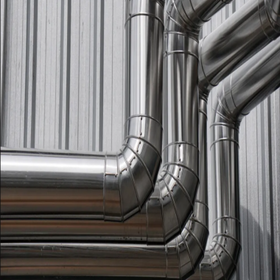
Corners are areas where thermal bypass often occurs. For sharp 90-degree bends, the most effective method is a mitre joint. This involves cutting the ends of two insulation tubes at 45-degree angles using a mitre box. When joined, these angles form a perfect 90-degree corner with a continuous thermal layer.
For curved or swept bends, a different technique is used to avoid compressing the foam on the inside of the curve. Small V-shaped notches are cut into the insulation at intervals along the inner side of the bend. These notches, typically cut at 30-degree angles, allow the insulation to flex around the curve without kinking or thinning.
T-Junctions and Valves
Insulating a T-junction requires a wedge-cut technique. A 90-degree wedge is cut out of the main run of insulation where the branch pipe exits. The end of the branching insulation tube is then cut at two 45-degree angles to form a point, which is fitted snugly into the wedge.
Valves and union fittings are often the most difficult areas to insulate. For domestic valves, specialized pre-formed insulation jackets can be used, but for standard foam tubes, the installer must carefully carve out the interior of the foam to accommodate the shape of the valve body. It is vital that the insulation fits as closely as possible around the valve stem to prevent heat loss at these points.
Sealing Seams and Joints
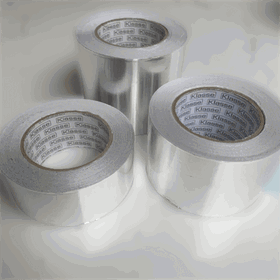
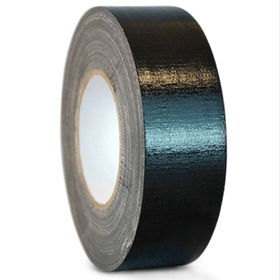
All longitudinal seams and butt joints between sections of insulation must be sealed. For self-seal products, this involves removing a protective strip and pressing the adhesive surfaces together. For standard foam, insulation tape or a brush-applied contact adhesive is required. The use of standard electrical or duct tape is generally discouraged for professional applications, as these tapes can degrade and lose their adhesion when subjected to the heat cycles of a plumbing system.
Condensation Physics and Moisture Management
In the UK, condensation is a significant driver for pipe insulation, particularly in refrigeration and air conditioning. To prevent condensation, the insulation must be thick enough to ensure that the temperature of its outer surface remains above the dew point of the ambient air.
The dew point is the temperature at which air can no longer hold its water vapour, causing it to condense into liquid. In a typical UK bathroom or kitchen, where humidity levels can be high, the dew point can be quite close to the ambient temperature. If a cold water pipe is at 10 degrees Celsius and the ambient air is at 25 degrees Celsius with 80% relative humidity, a minimum of 9mm of foam insulation is required to prevent "sweating".
For these applications, the insulation must also be vapour-tight. If moisture-laden air can penetrate through the insulation to reach the cold pipe, it will condense within the foam structure. This leads to saturated insulation, which not only ceases to insulate but also creates a corrosive environment for the pipework. Nitrile rubber is particularly effective here because its closed-cell structure provides a high resistance to water vapour diffusion, effectively acting as an integrated vapour barrier.
Economic Benefits and Energy Savings
The installation of foam pipe insulation is widely regarded as one of the most cost-effective energy efficiency measures available to UK property owners.
Heat Loss Reduction
Uninsulated heating pipes act like small radiators, dissipating heat into areas where it is not needed. A typical 22mm central heating flow pipe can lose around 30 Watts of heat for every metre of length. By applying 19mm of foam insulation, this loss is reduced to just 8 Watts per metre. For a property with ten metres of exposed pipework in a loft or floor void, this equates to a significant reduction in the energy demand on the boiler.
Financial Return
The Energy Saving Trust estimates that insulating the hot water pipes in a typical UK home can save around 20 pounds per year on energy bills. Given that a roll of polyethylene lagging can cost as little as 5 pounds, the initial investment is often recouped in just a few months. Furthermore, the cost of preventing a single burst pipe through proper insulation is a fraction of the cost of the insurance excess and the subsequent disruption caused by water damage.
Environmental Impact
Reducing heat loss directly reduces the amount of fuel burned by boilers, leading to lower carbon dioxide emissions. This is a key part of the UK’s strategy for meeting its environmental commitments under the Climate Change Act. By improving the efficiency of the thermal distribution system, insulation allows low-carbon heat sources, such as air source heat pumps, to operate more effectively.
Acoustic Insulation and Vibration Dampening
While thermal properties are the primary focus, foam pipe insulation also provides secondary benefits in terms of acoustic performance.
In modern buildings, the sound of water flowing through pipes—particularly from high-pressure systems or waste stacks—can be a source of annoyance. Foam lagging acts as a dampening material, absorbing the vibrations of the pipe and reducing the amount of noise transmitted into the building structure. Nitrile rubber and specialized acoustic foams are particularly effective at reducing noise levels by up to 10 to 15 decibels.
Foam insulation also helps to reduce the noise associated with the thermal expansion and contraction of pipes. As pipes heat up and cool down, they move slightly within their supports; without insulation, this can cause ticking or creaking sounds. Lagging provides a soft buffer that allows the pipe to move quietly.
Specialist Applications: External and Solar Systems
Pipes located outside the building envelope face the most extreme conditions and require specialized materials.
External Frost Protection
For pipes that are permanently exposed to the elements, such as those serving outdoor taps or external boilers, standard insulation thicknesses are insufficient. These applications demand a minimum of 32mm to 40mm of closed-cell foam. Additionally, the insulation must be protected from moisture ingress. If rainwater enters the insulation, it will freeze, and the lagging will lose its effectiveness. Weatherproof jackets, often made of aluminium or UV-resistant PVC, are required to keep the insulation dry.
Solar Thermal Systems
Solar heating systems present a unique challenge because the fluid temperatures can be extremely high, sometimes exceeding 150 degrees Celsius. Standard polyethylene and even some nitrile rubbers will melt or degrade at these temperatures. Specialized solar pipe insulation, usually made from EPDM rubber, is designed to withstand these high temperatures while remaining flexible in the winter. EPDM is also naturally resistant to UV radiation, meaning it does not require additional painting or cladding to survive in direct sunlight.
Condensate Pipes
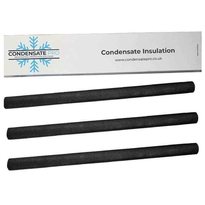
A frequent cause of boiler failure during UK cold snaps is the freezing of the condensate pipe. This is the plastic pipe that carries waste water away from a condensing boiler. Because this water moves slowly and the pipe is often located outside, it is highly susceptible to freezing. Insulating this pipe with UV-resistant foam lagging is a simple and effective way to ensure the boiler remains operational throughout the winter.
Maintenance and Long-Term Performance
Pipe insulation is subject to wear and degradation over time, and its effectiveness should be periodically reviewed.
Inspection Schedule
A professional inspection of pipe lagging should be carried out annually, ideally before the start of the heating season. This is to ensure that all tape seals are still intact and that no sections have become loose or damaged. In lofts and garages, insulation can sometimes be damaged by household activity or disturbed by other trades working in the area.
Signs of Failure
Indicators that insulation may need replacement include:
Brittleness or Cracking: This is often a sign of UV damage in external pipes or excessive heat exposure in plant rooms.
Compression: If the foam has been crushed by heavy objects or over-tightened supports, it will no longer provide the intended thermal resistance.
Moisture or Mould: On chilled pipes, the presence of mould on the outside of the insulation suggests that the vapour barrier has been breached.
Sagging: On horizontal runs, sagging insulation can indicate that it has become saturated with water.
Expected Lifespan
Internally located polyethylene and nitrile rubber insulation can last for 15 to 20 years if undisturbed. However, externally located lagging, even when protected, typically has a shorter lifespan of 10 to 12 years due to the effects of temperature cycling and weathering.
Technical Summary of Insulation Metrics
When selecting materials for a UK project, engineers and contractors compare several key performance metrics to ensure the chosen solution is fit for purpose.
Thermal conductivity (Lambda) is the most critical factor for energy saving. However, the service temperature range must also be considered; a material that works well for a cold water pipe might fail if used on a high-temperature steam line. Fire safety, as defined by the Euroclass system, is mandatory for commercial specifications, particularly regarding smoke and droplet ratings in escape routes.
Material Property |
Polyethylene (PE) |
Nitrile Rubber (FEF) |
Phenolic Foam |
EPDM Rubber |
| Lambda (W/mK) | 0.034 - 0.040 | 0.033 - 0.036 | 0.025 | 0.036 - 0.040 |
| Lower Temp Limit | -45 C | -50 C | -50 C | -50 C |
| Upper Temp Limit | +105 C | +105 C | +120 C | +150 C |
| Fire Class (Typical) | Euroclass E | Euroclass B-s3, d0 | Euroclass B-s1, d0 | Euroclass C-E |
| Recyclability | High | Low | Low | Low |
The selection process also involves balancing upfront costs with long-term durability. While polyethylene offers the lowest initial cost, nitrile rubber’s superior moisture resistance and flexibility often result in a longer service life and better performance in challenging environments.
The Impact of Heat Pump Adoption on Insulation Standards
The UK’s transition from gas boilers to heat pumps is fundamentally changing how pipes are insulated. Heat pumps generally operate at lower flow temperatures, often between 35 and 45 degrees Celsius. At these lower temperatures, the temperature differential between the pipe and the room is smaller, meaning that any heat loss represents a larger percentage of the total energy delivered by the system.
To maintain the efficiency of a heat pump, it is required that the distribution losses are kept to an absolute minimum. This guide recommends that all heat pump pipework, including the internal runs, is insulated with a minimum thickness of 25mm. Furthermore, because many heat pumps involve external pipework connecting the outdoor unit to the internal system, the use of high-quality, weatherproof, and UV-stable insulation like EPDM is becoming the new standard for modern British homes.
The adoption of smart heating controls also relies on high-quality insulation. Smart thermostats and frost protection features function best when the system can maintain a consistent temperature throughout the house. Properly insulated pipes ensure that all radiators, even those farthest from the heat source, receive water at the intended temperature, allowing the control system to accurately regulate the building’s climate.