
- Blogs
- A Comprehensive Guide to UK PIR Polyisocyanurate Roof Insulation
A Comprehensive Guide to UK PIR Polyisocyanurate Roof Insulation


TLDR:
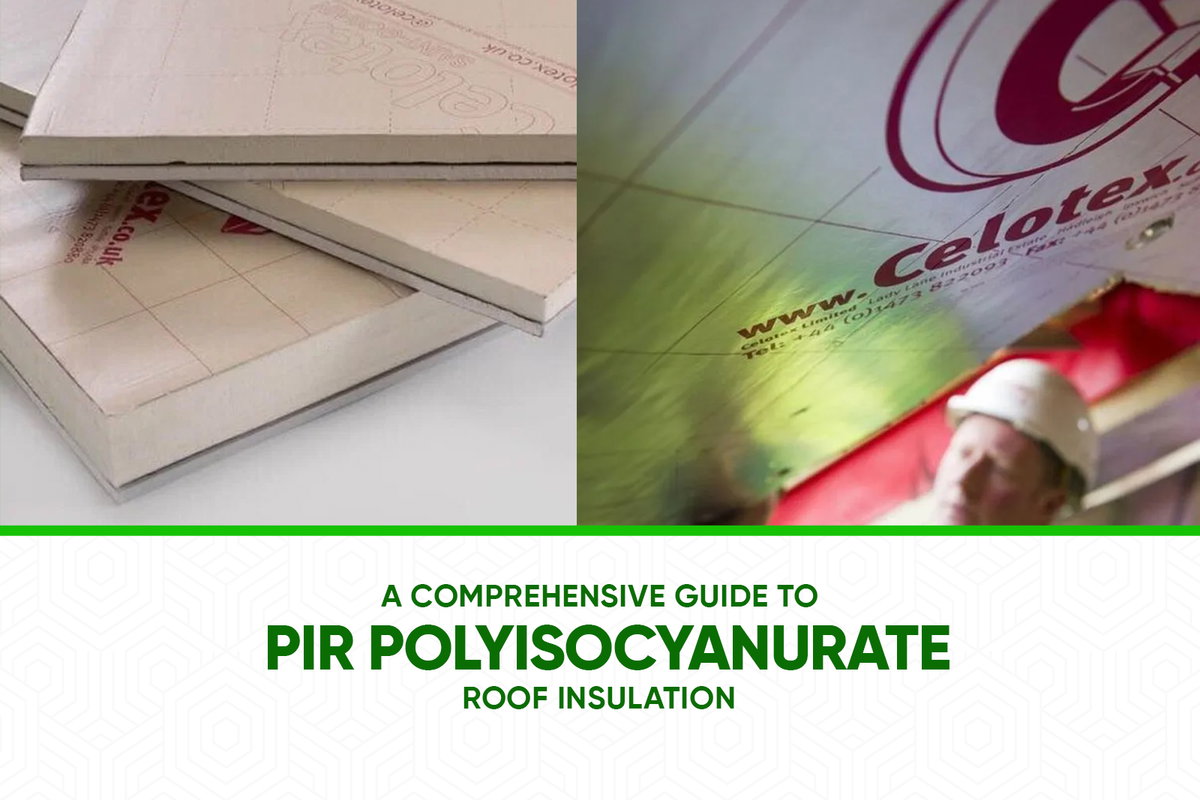
Polyisocyanurate (PIR) insulation is the industry-standard solution for high-performance roofing in the United Kingdom, offering a superior thermal conductivity of 0.022 W/mK. This guide details the technical specifications of major brands like Celotex, Kingspan, and Recticel, explains the 2025/2026 updates to Approved Document L of the Building Regulations, and provides professional installation strategies for pitched and flat roofs to eliminate thermal bridging and moisture risks.
The Evolution of Thermal Efficiency in UK Roofing
The United Kingdom has one of the oldest and least energy-efficient housing stocks in Europe. With approximately 25 per cent of heat loss in an uninsulated home occurring through the roof, the role of high-performance materials has become central to the national strategy for carbon reduction. While traditional mineral wool was the standard for decades, the transition toward rigid polyisocyanurate, or PIR, has been driven by the need for thinner insulation profiles that do not compromise on thermal resistance. PIR is a thermoset plastic produced as a foam and used as rigid thermal insulation, characterised by a high degree of cross-linking and a closed-cell structure.
The chemical stability of PIR allows it to maintain its shape and thermal properties over the life of a building. Unlike fibrous insulation, which can settle or lose its effectiveness if exposed to moisture, PIR remains durable and resistant to microbial growth. This durability is essential for the UK climate, where humidity and damp are persistent challenges for structural integrity. The adoption of PIR in both new build and refurbishment projects is now a requirement for meeting the stringent U-value targets set by the government.
The push toward net-zero carbon emissions by 2050 has led to several updates in the Building Regulations. Specifically, Approved Document L, which covers the conservation of fuel and power, has introduced the Future Homes Standard. This standard requires new homes to be zero-carbon ready, meaning they must possess high fabric standards and low-carbon heating systems. PIR insulation is a primary tool for achieving these high fabric standards, allowing builders to reach very low U-values within the spatial constraints of modern architectural designs.
Technical Composition and Performance Metrics of PIR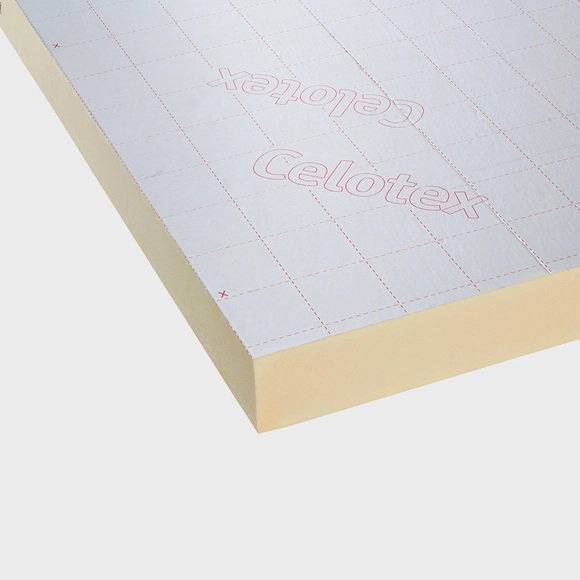
The primary performance indicator for any insulation material is its thermal conductivity, commonly expressed as the lambda value or λ-value. For the majority of high-quality PIR products available in the UK, the lambda value is 0.022 W/mK. This figure represents the rate at which heat passes through the material; the lower the value, the better the insulation. For comparison, traditional mineral wool often has a lambda value between 0.035 and 0.044 W/mK, meaning PIR is roughly twice as efficient for the same thickness.
The thermal resistance of the material, which is the R-value, is calculated by dividing the thickness of the board in metres by its thermal conductivity. This is the only instance where this specific term will be mentioned, as the UK industry focuses on the U-value of the completed building element. The efficiency of PIR allows for much shallower roof structures, which is a major advantage for loft conversions where head height is at a premium.
| Technical Property | Standard Specification | Reference Standard |
| Thermal Conductivity (Lambda) | 0.022 W/mK | BS EN 13165 |
| Compressive Strength | 120 - 150 kPa | BS EN 826 |
| Core Density | 31 - 35 kg/m3 | Manufacturer Data |
| Water Vapour Resistance | High (Foil-faced) | BS EN 12086 |
| Water Absorption | < 0.6% | BS EN 12087 |
PIR boards are typically manufactured with low-emissivity aluminium foil facings on both sides. These facings reflect radiant heat back into the building during winter and away from the building during summer. Additionally, the foil acts as an effective vapour control layer (VCL) when the joints between the boards are sealed with compatible aluminium tape. This integrated approach simplifies the construction process by combining thermal insulation and moisture management in a single product.
UK Regulatory Framework and U-value Requirements
The specification of roof insulation in the UK is dictated by the mandatory U-values set out in Approved Document L. These values vary depending on the type of roof and whether the work involves a new build, an extension, or the renovation of an existing structure. A U-value measures the thermal transmittance of a building element; the lower the U-value, the less heat escapes.
New Build Standards (2025-2026)
For new dwellings, the regulations have moved toward a notional dwelling target that requires exceptional levels of insulation. The area-weighted average for a new roof is typically expected to meet a U-value of 0.11 W/m2K. Achieving this with PIR usually requires a combination of insulation between and over or under the rafters to break the thermal bridges created by the timber.
| Roof Type (New Build) | Target U-value (W/m2K) | Recommended PIR Thickness |
| Pitched Roof (Ceiling Level) | 0.11 | 150mm - 200mm |
| Pitched Roof (Rafter Level) | 0.11 | 175mm - 225mm |
| Flat Roof | 0.11 | 150mm - 200mm |
Refurbishment and Extension Standards
When retrofitting an existing building or adding an extension, the requirements are slightly different. The threshold for thermal improvement is triggered if the existing roof has a U-value worse than 0.35 W/m2K. In these cases, the roof must be upgraded to meet the following standards:
| Roof Application (Existing) | Target U-value (W/m2K) | Typical PIR Configuration |
| Pitched Roof (Insulated at Ceiling) | 0.16 | 150mm PIR |
| Pitched Roof (Insulated at Rafters) | 0.18 | 120mm - 140mm PIR |
| Flat Roof | 0.18 | 120mm - 150mm PIR |
The approach to these targets often involves practical constraints. If it is not technically or economically feasible to reach the target U-value within a 15-year payback period, the building control officer may allow the best possible U-value that is achievable. However, the threshold U-value of 0.35 W/m2K must always be improved upon during any significant renovation.
Leading PIR Manufacturers in the UK Market
The UK market is served by several major manufacturers who produce PIR boards that are technically similar but differ in their specialised applications and branding. For the majority of residential projects, products from Celotex, Kingspan, Recticel, EcoTherm, IKO, and Unilin (formerly Xtratherm) are considered interchangeable if they meet the same lambda value and compressive strength.
Celotex
Celotex is a widely recognised brand in the UK, offering a range of PIR boards that are categorised by their thickness and application. Their product lines are split into three main series:
-
TB4000: Thin boards ranging from 20mm to 40mm, used for small gaps and thermal bridging.
-
GA4000: General-purpose boards ranging from 50mm to 100mm, suitable for most roof, wall, and floor applications.
-
XR4000: Extra-thick boards ranging from 110mm to 200mm, designed for high-performance projects and meeting low U-values in a single layer.
Kingspan
Kingspan is known for its extensive range of specialised products. In addition to their Therma PIR range, they offer the Kooltherm range, which is a phenolic insulation with even lower thermal conductivity (as low as 0.018 W/mK). Their key PIR products for roofing include:
-
Thermapitch TP10: Specifically marketed for pitched roofs.
-
Thermaroof TR26 and TR27: Designed for flat roofs, with facings suitable for different waterproofing membranes.
Recticel
Recticel offers high-performance boards that are frequently used in both domestic and commercial settings. Their Eurothane GP is a multi-purpose board used for roofs, walls, and floors. For flat roofs, they provide the Powerdeck and Eurodeck series, which are engineered to withstand the compressive loads of maintenance traffic and various roof coverings.
EcoTherm and IKO
EcoTherm produces the Eco-Versal range, a universal board that is often a cost-effective alternative to larger brands while maintaining the standard 0.022 W/mK performance. IKO enertherm is another prominent choice, featuring Micro Cell Technology (MCT), which provides a finer cell structure for enhanced shape retention and moisture resistance.
Pitched Roof Insulation Strategies
Pitched roofs in the UK are generally insulated in one of two ways: at the ceiling level (cold roof) or at the rafter level (warm roof). The choice between these methods depends on the intended use of the loft space.
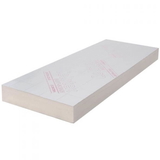
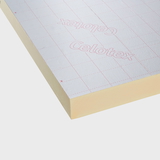
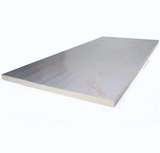
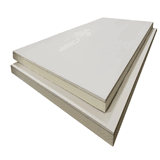
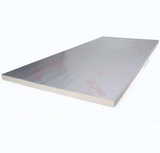
Buy Polyisocyanurate Roof Insulation
Cold Roof Configuration
In a cold roof, the insulation is laid horizontally between and over the ceiling joists. This keeps the living space below warm but leaves the loft space cold. While mineral wool is common for this, PIR boards are used when the loft needs to be boarded for storage. Using PIR prevents the compression that would occur with wool, which significantly reduces insulation effectiveness. For a cold roof to meet the 0.16 W/m2K target, a PIR thickness of approximately 150mm is required.
Warm Roof Configuration
A warm roof involves insulating the rafters themselves, bringing the loft space into the thermal envelope of the house. This is the standard approach for loft conversions or vaulted ceilings. PIR is ideal here because its high efficiency allows for thinner layers, preserving internal space.
To reach the required U-values, it is common to use two layers of PIR:
-
Between Rafters: PIR boards are cut and fitted tightly between the timber rafters. A 50mm ventilation gap must be maintained between the top of the insulation and the roofing felt or membrane, unless a vapour-permeable breather membrane is used.
-
Under Rafters: A continuous layer of thinner PIR (e.g., 25mm to 50mm) is fixed to the underside of the rafters before plasterboarding. This layer is essential to break the thermal bridge caused by the rafters themselves.
Flat Roof Insulation Systems
Flat roofs present unique challenges, particularly regarding drainage and the risk of standing water. There are three primary ways to insulate a flat roof: warm deck, cold deck, and inverted roof. PIR is the most frequent choice for warm deck systems.
Warm Deck Flat Roofs
In a warm deck roof, the insulation is placed above the structural deck but below the waterproofing membrane. This keeps the structural deck at a similar temperature to the building interior, which virtually eliminates the risk of condensation forming within the roof structure.
PIR boards for flat roofs must have sufficient compressive strength to handle maintenance traffic. A standard requirement is 150 kPa at 10 per cent compression.10 The facing of the board must also be compatible with the waterproofing system:
-
Foil-faced PIR: Suitable for mechanically fixed single-ply membranes or cold-applied liquid systems.
-
Glass tissue or bituminous-faced PIR: Required for torch-applied bituminous felt systems to prevent delamination of the foil under heat.
Cold Deck Flat Roofs
A cold deck roof places the insulation between the joists, with a ventilated void above it. This is less common in modern construction because it is difficult to provide adequate ventilation to the centre of a large flat roof, which can lead to moisture accumulation and timber rot. If a cold deck must be used, PIR is preferred for its moisture resistance, but careful detailing of the air pathways is necessary.
Professional Installation and Workmanship
The thermal performance of PIR is only as good as the quality of the installation. Poor workmanship can lead to thermal bridging, air leakage, and interstitial condensation.
Precise Cutting and Fitting
PIR boards must be cut accurately to ensure there are no gaps. A common professional method is the "score and snap" technique:
-
Measure the space between rafters or joists at multiple points.
-
Mark the board and score one side with a sharp utility knife.
-
Snap the board over a straight edge and cut the foil on the reverse side.
-
For more complex cuts or when using thicker boards (e.g., XR4000), a fine-toothed insulation saw is more appropriate.
Boards should be cut slightly oversized (by about 5mm) to create a tight "friction fit" between timbers.17 If gaps are unavoidable due to warped timbers, they should be filled with low-expansion gap-filling foam to maintain the integrity of the thermal barrier.
Eliminating Thermal Bridging
Thermal bridging occurs where a structural element passes through the insulation layer, creating a path for heat to escape. In a roof, the timber rafters are the primary thermal bridges. Heat loss through these bridges can account for up to 30 per cent of a building's total heat loss.25 To prevent this, insulation should be continuous. Adding a second layer of PIR over or under the rafters is the most effective way to ensure a complete thermal envelope.
Photographic Evidence Requirements
Under the 2021 updates to Approved Document L, installers are now required to take photographic evidence of the insulation at key stages of the project. These photos must show that the insulation is continuous, that there are no gaps, and that thermal bridging has been addressed before the work is covered by plasterboard or roofing membranes.23 This is a critical step for obtaining building control sign-off.
Moisture Management and Vapour Control
The UK climate necessitates a robust strategy for managing moisture within the roof structure. Warm, moist air from inside a house will naturally migrate toward the colder outside air. If this air reaches a cold surface within the roof, it will condense into liquid water.
The Role of the Vapour Control Layer (VCL)
A VCL must be installed on the warm side of the insulation (the interior side) to prevent water vapour from entering the roof structure. For PIR installations, there are several ways to achieve this:
-
Foil Taping: Since PIR is foil-faced, the boards themselves can act as a VCL. All joints between boards must be sealed with a high-quality aluminium foil tape.
-
Dedicated Membranes: A separate vapour control membrane, such as a 1000-gauge polythene sheet, can be installed over the PIR before the plasterboard is fixed.
-
Sealing Penetrations: Any penetrations through the VCL, such as for electrical cables or light fittings, must be sealed with tape or specialised grommets to maintain airtightness.
Ventilation Requirements
In cold roof configurations or where non-permeable roofing felt is used, ventilation is essential to allow any moisture that does bypass the VCL to escape. A minimum 50mm air gap is required above the insulation, with vents at the eaves and ridge to promote airflow.1 Blocking these ventilation paths with insulation is a common mistake that leads to damp and structural damage.
Fire Performance and Building Safety 
Fire safety is a critical consideration in the specification of any building material. In the UK, materials are classified according to their reaction to fire using the Euroclass system (BS EN 13501-1).
Euroclass Ratings for PIR
Most standard PIR boards achieve a Euroclass E or F rating, which means they are combustible. While PIR contains fire retardants that help it char and resist flame spread better than expanded polystyrene (EPS), it is not a non-combustible material.
| Material | Euroclass Rating | Fire Performance |
| Mineral Wool | A1 | Non-combustible |
| Phenolic Foam | C or D | Limited combustibility |
| PIR | E or F | Combustible |
Because PIR is combustible, it must be used in conjunction with fire-resistant barriers in certain applications. For domestic roofs, this usually means that the insulation must be covered by a fire-resistant internal lining, such as 12.5mm fire-rated plasterboard, which provides 30 minutes of fire resistance to protect the occupants while they evacuate.
Smoke and Toxicity
Another consideration is the production of smoke and toxic fumes during combustion. PIR can release hydrogen cyanide and carbon monoxide when it burns, which are dangerous in an enclosed space. This is why correct installation behind fire-rated finishes and the use of fire-stopping at penetrations are essential for compliance with Part B of the Building Regulations.
Economic and Environmental Life Cycle
Investing in high-quality PIR insulation offers significant long-term financial and environmental benefits. While the initial cost of PIR is higher than that of mineral wool, the energy savings over the lifetime of the building often justify the expenditure.
Energy and Cost Savings
Properly insulating a roof can save a household between £600 and £1500 per year on energy bills, depending on the size of the property and the current energy prices. Because PIR does not settle or degrade, these savings remain consistent for the lifetime of the building, which is typically estimated at over 60 years.
Sustainability and Embodied Carbon
PIR manufacturers in the UK have made strides in reducing the environmental impact of their products. Most PIR is now manufactured using blowing agents with zero Ozone Depletion Potential (ODP) and low Global Warming Potential (GWP).5 Furthermore, because PIR is so efficient, less material is required to achieve the target U-value compared to traditional insulators, which reduces the carbon footprint associated with transportation and storage.
| Aspect | PIR Benefit | Environmental Impact |
| Efficiency | Half the thickness of wool | Lower transport emissions |
| Durability | Lasts 60+ years | Reduced replacement waste |
| Blowing Agents | Zero ODP / Low GWP | Minimal atmospheric impact |
| Recyclability | Some PET content | Use of recycled plastics |
Common Installation Pitfalls to Avoid
Even with the best materials, a roof can fail if the insulation is not fitted correctly. Building control officers frequently identify the following errors during inspections:
-
Gaps and Voids: Small gaps between boards allow for thermal bypass, where air moves around the insulation. Even a 10mm gap can reduce the effectiveness of the entire roof by a significant margin.
-
Compressing Insulation: This is more common with mineral wool, but attempting to force a thick PIR board into a shallow cavity can damage the board or the structure and lead to air gaps behind the insulation.
-
Blocking Ventilation: In cold roofs, pushing insulation too far into the eaves can block the airflow from soffit vents, leading to condensation and rot.
-
Missing Tapes: Failing to seal the joints with aluminium foil tape compromises the vapour control layer, increasing the risk of interstitial condensation.
-
Thermal Bridging: Not using a continuous layer over or under rafters is a major cause of heat loss and can result in cold spots on the ceiling where mould is likely to grow.
Future Trends in UK Roof Insulation
The trajectory of the UK insulation market is toward even higher levels of performance and environmental accountability. As the Future Homes Standard becomes fully operational, we are likely to see several developments:
-
Increased Use of Phenolic and VIPs: For ultra-high performance or extremely tight spaces, phenolic boards or Vacuum Insulation Panels (VIPs) like Kingspan Optim-R may become more common, despite their higher cost.
-
Bio-Based Polyols: Manufacturers are researching ways to replace petroleum-based polyols in PIR production with plant-based alternatives to reduce embodied carbon.
-
Smart Roofs: The integration of moisture sensors within the roof build-up to provide early warnings of leaks or condensation issues is an emerging trend in high-end residential construction.
-
Standardisation of Workmanship: Enhanced training and certification for installers will likely be required to ensure that the as-built performance of buildings matches the architectural design.
Conclusion
PIR polyisocyanurate roof insulation is a central component of modern UK construction. Its exceptional thermal performance, durability, and moisture resistance make it the preferred choice for meeting the rigorous demands of the current Building Regulations. Whether for a new build reaching for a 0.11 U-value or a loft conversion requiring a slimline solution, PIR provides a reliable and cost-effective way to reduce energy consumption and improve occupant comfort. By selecting the correct products from reputable manufacturers and following professional installation practices to eliminate thermal bridging and manage moisture, homeowners and builders can ensure that their roofs remain efficient and durable for decades to come.
UK Legal Disclaimer
The information provided in this article is for general guidance and informational purposes only. It does not constitute professional advice, and it should not be used to specify materials or construction methods for any specific project. Building Regulations in the United Kingdom (England, Wales, Scotland, and Northern Ireland) are subject to frequent updates and regional variations. All architectural and insulation specifications must be checked and approved by a qualified building professional, such as a chartered architect, structural engineer, or building control officer, before work commences. No liability is accepted for any loss or damage arising from the use of this information. Professional site-specific advice is essential for compliance with health, safety, and fire regulations.

Samuel Hitch
Managing Director
Buy Insulation Online.
Leave A Reply
Your feedback is greatly appreciated, please comment on our content below. Your email address will not be published. Required fields are marked *