
- Blogs
- Is EPS Insulation Non-Breathable? A Comprehensive UK Guide
Is EPS Insulation Non-Breathable? A Comprehensive UK Guide

TLDR (Too Long; Didn't Read)
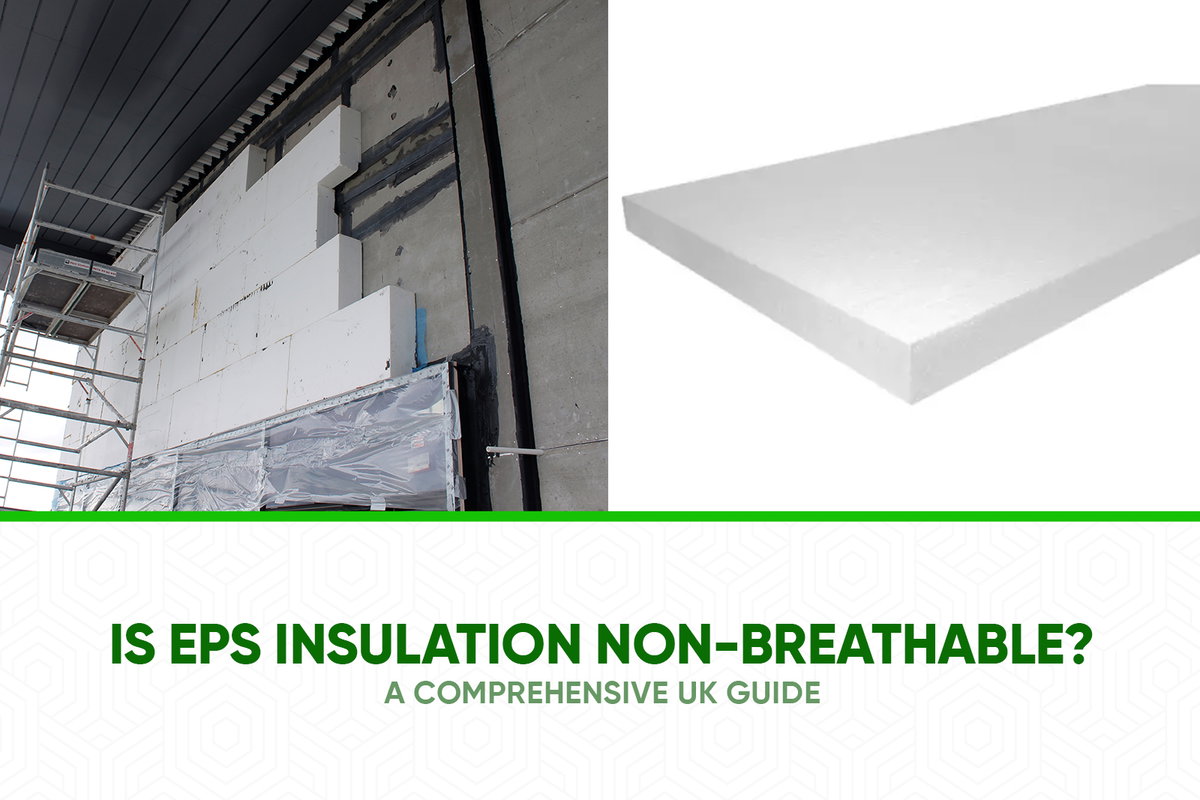
Expanded Polystyrene (EPS) insulation is not non-breathable. It is a vapour-permeable material, which means it allows water vapour (moisture in its gaseous state) to pass through it. This property helps to prevent moisture from becoming trapped within a building's structure.
However, its level of permeability is moderate. It is significantly more breathable than Extruded Polystyrene (XPS) or foil-faced insulation boards, but less breathable than materials like mineral wool or wood fibre. The unique manufacturing process of EPS, where closed-cell beads are fused together, leaves tiny channels between the beads that allow vapour to travel.
The "breathability" of the insulation material alone does not guarantee a healthy, moisture-free building. The performance of the entire construction system—including renders, membranes, vapour control layers (VCLs), and ventilation—is what truly matters. In the UK, the design of building elements must comply with standards such as BS 5250 (Management of moisture in buildings), which requires a holistic approach to prevent harmful condensation. When specified and installed correctly as part of a British Board of Agrément (BBA) certified system, EPS meets UK Building Regulations for moisture control.
Understanding 'Breathability' in UK Building Construction
In the context of UK building construction, particularly concerning older, solid-walled properties, the term 'breathable' is frequently used but often misunderstood. It does not refer to the movement of air but specifically describes the ability of building materials to transport moisture. A breathable structure is one that allows water vapour to pass through its fabric, preventing the accumulation of harmful levels of water that can damage materials and affect occupant health.
The Three Mechanisms of Moisture Movement
To fully grasp how building materials interact with moisture, it is important to understand the three primary transport mechanisms. The effectiveness of a material in managing moisture depends on its performance across these areas.
-
Vapour Permeability: This is the property most commonly associated with the term 'breathability'. It refers to a material's ability to allow water in its gaseous state (water vapour) to diffuse through it. Many traditional building materials are vapour permeable due to their porous structure.
-
Hygroscopicity: This describes a material's capacity to absorb and release water vapour from the surrounding air, acting as a 'moisture buffer'. Materials like natural wood fibres, sheep's wool, clay, and lime are highly hygroscopic. They help to regulate internal humidity levels by absorbing excess moisture when humidity is high and releasing it when it is low.
-
Capillarity (Wicking): This is the movement of water in its liquid form through the microscopic pores within a material, similar to how a sponge soaks up a spill. This mechanism is particularly relevant in solid masonry walls, where it can help transport liquid water from the core of the wall to a surface where it can evaporate.
Why Effective Moisture Management is Paramount
Poor moisture control within a building's fabric can have severe consequences. As buildings are constructed to be more airtight to improve energy efficiency, the management of internal moisture becomes even more critical. Activities such as cooking, bathing, and even breathing generate significant amounts of water vapour.
If this moisture-laden air cannot escape, it can lead to two primary problems:
-
Interstitial Condensation: This occurs when warm, moist air from inside the building penetrates the structure (e.g., a wall or roof) and cools to its dew point within the fabric. The water vapour then condenses back into liquid water. Trapped liquid water can significantly reduce the thermal performance of insulation and lead to the decay of structural components like timber joists and rafters.
-
Surface Condensation: This is visible condensation that forms on the internal surfaces of a building, often in corners or behind furniture where air circulation is poor. It leads to damp patches and creates the ideal conditions for mould growth, which can release spores that are harmful to human health and damage decorative finishes.
The modern drive for highly insulated, airtight homes has made the vapour permeability of construction materials a central issue. An airtight building envelope prevents heat loss but also traps moisture. A vapour-permeable construction provides a pathway for this trapped moisture to escape safely to the outside, preventing it from condensing within the structure. This means that a well-designed building envelope must balance airtightness for thermal performance with vapour permeability for moisture management.
Measuring Vapour Performance: The Technical Details 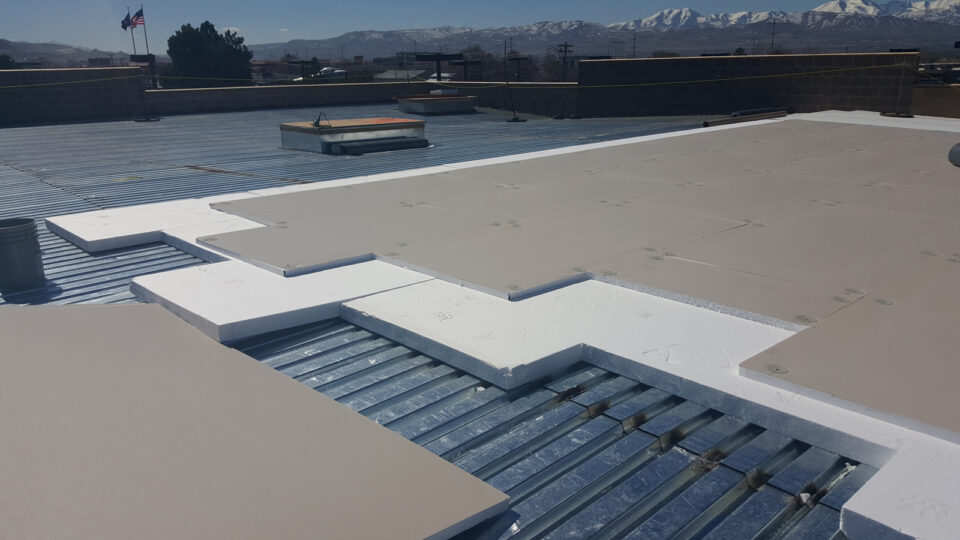
Relying on vague marketing terms like 'breathable' is insufficient for professional specification. To properly assess a material's ability to manage water vapour, it is essential to use quantifiable metrics. When evaluating a product, manufacturers should be able to provide specific data to validate their performance claims.
Key UK Metrics Explained
In the UK, the following metrics are used to define a material's vapour performance:
-
Water Vapour Resistance (MNs/g): This measures a material's reluctance to allow water vapour to pass through it at a specific thickness. It is measured in meganewton seconds per gram ($MNs/g$). A lower value indicates that the material is more permeable (more 'breathable'). For example, traditional lime render at 19mm thick has a vapour resistance of approximately $1.0 MNs/g$, which is considered highly permeable. Materials with a vapour resistance below $2.5 MNs/g$ are often considered suitable for use in older buildings.
-
Water Vapour Resistance Factor (mu-value): This is a dimensionless property of the bulk material, independent of its thickness. It compares the material's vapour resistance to that of an equivalent thickness of still air, which has a $\mu$-value of 1. A lower $\mu$-value signifies higher permeability. For instance, unfaced mineral wool has a $\mu$-value of around 1, making it highly permeable, whereas cement-based plaster can have a $\mu$-value of 75–250, making it highly resistant to vapour.
-
Equivalent Air Layer Thickness (s_d-value): This metric provides an intuitive measure of vapour resistance. It is calculated by multiplying the material's $\mu$-value by its thickness in metres ($s_d = \mu \times t$). The result is the thickness of a stationary layer of air that would have the same resistance to water vapour. For example, a material with an $s_d$-value of $2m$ has the same vapour resistance as a 2-metre-thick layer of still air.
The overall performance of a building element, such as a wall or roof, depends on the combined properties of all its layers. A wall is a multi-layered system that may include plasterboard, a vapour control layer, insulation, sheathing, membranes, and an external render. The total vapour resistance of the wall is the sum of the resistances of each of these components, including any adhesives used.
A fundamental principle of moisture-safe design is that the construction should become progressively more vapour-permeable from the warm side (interior) to the cold side (exterior). This ensures that any small amount of moisture that enters the structure has an easy path to escape to the outside, rather than becoming trapped between two impermeable layers. This is why a specifier must assess the vapour resistance of the entire system, not just the insulation board in isolation.
Expanded Polystyrene (EPS): A Material Profile
Expanded Polystyrene (EPS) is a rigid foam insulation material widely used in UK construction for its thermal performance, durability, and cost-effectiveness.
Manufacturing and Composition
The manufacturing process for EPS is key to understanding its physical properties.
-
Pre-expansion: The process begins with small, solid polystyrene beads. These beads are impregnated with a blowing agent, typically pentane. When heated with steam to temperatures above $90^{\circ}C$, the thermoplastic beads soften, and the blowing agent vaporises, causing the beads to expand to between 20 and 50 times their original size. Each expanded bead consists of a matrix of tiny, closed cells containing trapped air.
-
Maturing: The expanded beads are then allowed to cool and mature in large silos for 6-12 hours. During this time, the blowing agent condenses, creating a partial vacuum within the beads, which is then equalised by the diffusion of air into the cells.
-
Moulding: Finally, the matured beads are transferred into a large mould, where they are fused together using more steam. This process bonds the individual expanded beads into a large, solid block of EPS. These blocks are then cut using hot wires into boards of the required thickness and size. The final product is approximately 98% air, trapped within the closed-cell structure.
Buy EPS Insulation
Key Material Characteristics
-
Lightweight: Being composed of 98% air, EPS is exceptionally lightweight, which makes it easy to transport, handle, and install on site.
-
Moisture Resistant (Liquid Water): The individual beads of EPS have a closed-cell structure, making the material hydrophobic. It does not readily absorb liquid water and has a high capacity to dry out if it becomes wet, helping to prevent mould growth.
-
Durable and Stable: EPS is rot-proof, inert, and offers excellent dimensional stability. It does not sag or settle over time, which ensures that thermal gaps do not form within the insulation layer, maintaining the building's thermal integrity for its entire lifespan.
-
Cost-Effective: Compared to other rigid insulation materials like PIR or mineral wool, the manufacturing process for EPS is generally less energy-intensive and cheaper, making it a highly cost-effective solution for many applications.
The Verdict: Vapour Permeability of EPS Insulation
Expanded Polystyrene is a vapour-permeable insulation material. It is not a vapour barrier, nor is it as permeable as fibrous insulation like mineral wool. It occupies a middle ground, often functioning as a vapour retarder, slowing the passage of moisture vapour rather than stopping it completely.
The Structural Reason for its Permeability
The source of its permeability lies in its unique structure. While the individual polystyrene beads are themselves 'closed-cell', the process of fusing these beads together in a mould leaves microscopic channels and voids between them. It is through this network of interstitial pathways that water vapour can diffuse through the material.
This is the fundamental difference between EPS and Extruded Polystyrene (XPS). XPS is manufactured through a continuous extrusion process that creates a homogenous, closed-cell matrix with no voids between the cells. This structure gives XPS a much higher resistance to water vapour diffusion, making it significantly less 'breathable' than EPS.
Quantifying EPS Permeability
Data from manufacturers and technical documents confirm the vapour-permeable nature of EPS.
-
The mu-value (water vapour resistance factor) for EPS typically ranges from 20 to 70, depending on the density of the product.
-
This translates to a specific vapour resistance (MNs/g) that is dependent on the thickness of the board. For example, a plasterboard laminate with a 40mm EPS core has a vapour resistance of around $4.92 MNs/g$.
EPS in Context: A Comparative Analysis
To understand the practical implications of these figures, it is useful to compare EPS with other common insulation materials used in the UK. The following table provides a clear comparison of their typical vapour resistance properties.
| Insulation Material | Typical Vapour Resistance Factor (μ-value) | Vapour Resistance of 100mm Thickness (MNs/g, approx.) | General Classification |
| Mineral Wool (Unfaced) | $\sim1$ | $\sim0.5$ | Highly Vapour Permeable |
| Wood Fibre | 3 - 5 | 1.5 - 2.5 | Vapour Permeable |
| Expanded Polystyrene (EPS) | 20 - 70 | 10 - 35 | Vapour Permeable / Vapour Retarder |
| Polyisocyanurate (PIR) (Unfaced Core) | 30 - 50 | 15 - 25 | Vapour Resistant |
| Extruded Polystyrene (XPS) | 80 - 250 | 40 - 125 | Highly Vapour Resistant |
| Polyisocyanurate (PIR) (Foil-Faced) | Effectively Infinite ($>100,000$) | $>50,000$ | Vapour Barrier |
This comparison clearly shows that EPS is significantly more vapour permeable than XPS and foil-faced PIR boards, which act as vapour barriers. However, it is considerably less permeable than mineral wool and wood fibre insulation. This positions EPS as a versatile material that can be used in a wide range of constructions, provided the overall system is designed correctly.
Compliance and Standards: Using EPS in the UK
The use of EPS insulation in UK construction is governed by a framework of British Standards and third-party certifications that ensure its safe and effective performance, particularly in relation to moisture management.
The Overarching Guidance: BS 5250 Management of Moisture in Buildings 
BS 5250 is the principal British Standard providing a code of practice for the management of moisture in buildings. The 2021 update to this standard broadened its scope significantly, moving from a narrow focus on condensation to a holistic approach covering all sources of moisture, including rain penetration and ground moisture.
The standard requires designers to undertake a condensation risk analysis for any proposed construction element (wall, roof, or floor). This analysis, often carried out using the methodology in BS EN ISO 13788 (the Glaser method), must demonstrate that the design prevents harmful surface condensation and ensures that any interstitial condensation that might form during winter can dry out during warmer months, preventing cumulative moisture build-up.
Product-Specific Standard: BS EN 13163
This is the harmonised European Standard that sets out the technical specifications for factory-made expanded polystyrene (EPS) insulation products. Compliance with BS EN 13163 ensures that an EPS board meets its declared performance characteristics for properties such as thermal conductivity, dimensional stability, compressive strength, and behaviour under moisture.
Third-Party Verification: BBA Certification
The British Board of Agrément (BBA) is a leading independent body in the UK that assesses, tests, and certifies construction products and systems. A BBA certificate for an EPS insulation system (such as an External Wall Insulation system) provides independent verification that it is fit for its intended purpose in the UK market.
The certification process involves rigorous testing of the entire system for durability, structural stability, behaviour in relation to fire, and moisture management. BBA certificates for EPS systems explicitly state that, when installed in accordance with the certificate's requirements, the system can satisfy the relevant clauses of the UK Building Regulations, including those concerning resistance to moisture and condensation. The certificate also typically confirms a minimum service life for the system, often 30 years or more.
The modern approach to building design has moved away from simple prescriptive rules towards a more sophisticated, performance-based assessment. The responsibility lies with the designer or specifier to use the manufacturer's certified data to conduct a formal risk analysis. This process proves that the complete system will perform as required within the specific context of the project, considering its location, construction type, and intended use.
Best Practices for Moisture-Resilient Installation
The theoretical performance of EPS can only be realised through correct installation. Poor detailing or workmanship can compromise any design, leading to moisture-related problems.
Application in External Wall Insulation (EWI) Systems
EWI is one of the most common applications for EPS in the UK. The following practices are essential for a durable, moisture-resilient installation:
-
Substrate Preparation: The wall surface must be structurally sound, clean, and dry. Any pre-existing damp issues, such as those from leaking gutters or a failed damp-proof course, must be fully rectified before the EWI system is applied.
-
Starter Tracks: A metal or PVC starter track must be fixed horizontally at the base of the system, at least 150mm above external ground level. This track provides a level starting point and protects the bottom edge of the insulation from ground moisture and splash-back. It must be installed in line with the building's damp-proof course (DPC) but must not bridge it.
-
Board Fixing: Insulation boards should be fixed in a staggered, 'brick-bond' pattern to avoid continuous vertical joints. They are typically fixed using a combination of a specialised adhesive (applied to ensure at least 40% coverage) and mechanical fixings designed for the specific substrate.
-
Managing Gaps: It is critical to ensure boards are tightly butted together. Any small gaps (less than 2mm) should be filled with expanding foam. Larger gaps must be filled with cut slivers of EPS insulation to maintain thermal continuity and prevent thermal bridging.
-
System Integrity: All components—adhesive, insulation, fixings, reinforcing mesh, basecoat, and final render—should be sourced from a single system designer and be covered by a single BBA certificate. Mixing and matching components from different manufacturers is poor practice, invalidates warranties, and compromises the system's tested performance.
Application in Floors and Roofs - The Role of the Vapour Control Layer (VCL)
When EPS is used on the 'warm' side of a construction, such as in a ground floor or a warm roof, the management of internal water vapour becomes critical.
-
Fundamental Principle: A Vapour Control Layer (VCL) is a membrane with high vapour resistance that is installed on the warm side (the room side) of the insulation. Its purpose is to limit the amount of water vapour from the occupied space that can diffuse into the building structure.
-
Ground-Bearing Concrete Floors: A typical build-up involves laying a damp-proof membrane (DPM) over the sub-base, followed by the concrete slab, the EPS insulation, and then a VCL (often a polythene sheet) before the final floor screed is poured. The VCL protects the insulation from the wet screed and prevents moisture from the room from being driven into the colder floor structure.
-
Pitched Roofs (Warm Roof Construction): When insulating at rafter level, the VCL is installed directly behind the internal plasterboard finish, on the warm side of the insulation. This prevents water vapour generated within the home from reaching the cold roof timbers and underlay, where it could condense and cause rot.
-
Sealing is Critical: A VCL is only effective if it forms a continuous, sealed barrier. All joints and laps must be sealed with the appropriate tape, and any penetrations for services like pipes or cables must be carefully sealed to maintain the integrity of the layer.
Conclusion: A Balanced Approach to Using EPS
Expanded Polystyrene (EPS) is a vapour-permeable insulation material. Its performance characteristics place it between highly permeable products like mineral wool and highly resistant vapour barriers like foil-faced PIR. It is not 'non-breathable'.
The suitability of EPS for a given project is not an intrinsic property of the material itself but is entirely dependent on its application within a well-designed, correctly installed, and certified system. The critical question for a designer or specifier is not whether EPS is "breathable" in isolation, but whether the complete building element—be it a wall, floor, or roof—has been designed and analysed in accordance with UK standards, principally BS 5250, to effectively manage moisture for the life of the building.
When this holistic, system-based approach is taken, and when installation is carried out to high standards using BBA-certified systems, EPS is a proven, reliable, and compliant insulation material for the UK construction market.
Legal Disclaimer
The information provided in this article is for general informational purposes only and is not intended to be a definitive statement of law or to constitute professional, legal, or technical advice. The content comprises the views of the author and should not be used as a substitute for consultation with a qualified professional adviser, such as an architect, surveyor, or structural engineer, for advice on specific projects.
While endeavours are made to ensure the information is accurate and up-to-date, no liability is accepted for any damages arising in contract, tort, or otherwise from the use of, or inability to use, this article or any material contained within it, or from any action or decision taken as a result of using this content. You should not rely on this information for the purpose of specifying materials or making construction decisions.

Samuel Hitch
Managing Director
Buy Insulation Online.
Leave A Reply
Your feedback is greatly appreciated, please comment on our content below. Your email address will not be published. Required fields are marked *