
- Blogs
- The Benefits of Jablite Insulation: A Comprehensive Guide for UK Specifiers
The Benefits of Jablite Insulation: A Comprehensive Guide for UK Specifiers
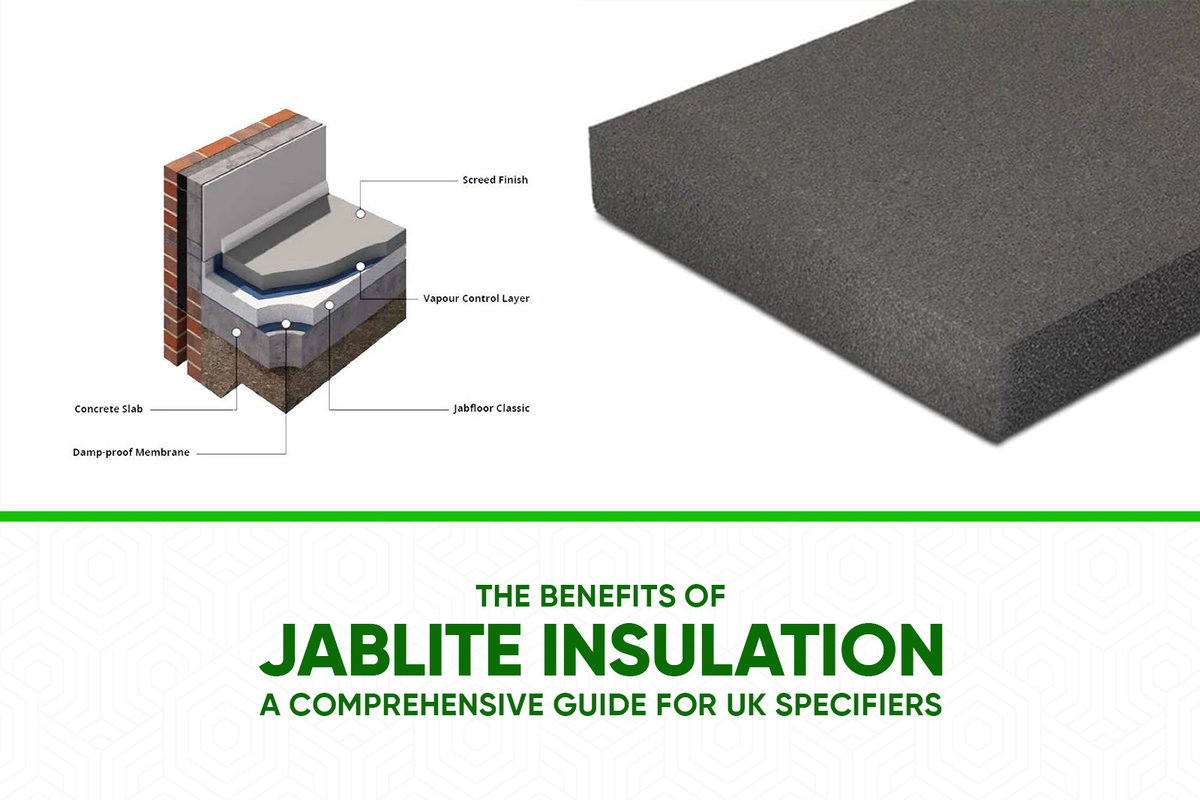

Core Advantages and Longevity in the UK Built Environment
The Role of Jablite EPS in Thermal Regulation
Jablite insulation comprises a range of expanded polystyrene (EPS) products specifically designed for use across building envelopes, including floors, walls, and roofs. This material functions as a high-performance, lightweight, cellular plastic, offering robust thermal resistance. Its structure ensures consistent thermal performance across the temperature ranges commonly found within buildings.
The fundamental purpose of Jablite is to reduce heat flow, thereby achieving the stringent U-values required by contemporary building codes. The material’s ability to minimise heat loss translates directly into reduced energy consumption for heating and cooling, providing long-term energy savings.
To meet the continuously increasing thermal efficiency requirements in the UK, Jablite offers High Performance (HP) variants. These HP boards are distinguishable by their dark grey colour, which results from the inclusion of a carbon additive. This additive disperses and reflects heat radiation, conferring an improvement in thermal performance compared to standard white EPS boards. For instance, the HP insulation can achieve a declared thermal conductivity ( λD?) as low as 0.032 W/mK. This technical achievement is particularly relevant where space is limited, as the improved conductivity allows specifiers to achieve regulatory thermal targets with thinner boards, minimising the intrusion into living or working spaces.
Durability, Stability, and Lifespan Assessment
A key consideration in construction material specification is the product’s expected service life. EPS is recognised for its exceptional resilience. When installed correctly and protected within the building fabric, Jablite products are dimensionally stable and will remain effective as insulating materials for the life of the building in which they are incorporated. Industry estimates for EPS longevity typically range from 50 to 100 years, or potentially indefinitely, owing to the material’s robust resistance to environmental degradation.
This long service life is supported by the material’s dimensional stability. Maintaining structural integrity over time is essential, particularly in floor and wall systems. EPS is known for its property of reliable stability, subject to a maximum dimensional change of less than 2%, even under demanding environmental conditions.
Furthermore, Jablite EPS is inherently moisture-resistant, non-biodegradable, and resistant to the effects of freeze-thaw cycles. These properties are crucial for applications below the ground, such as basements and ground-bearing floors, ensuring the insulation retains its performance value even in high-moisture environments. It is important to note that while the material itself resists moisture, its effective lifespan is conditional upon meticulous system protection against chemical exposure and water ingress. For example, the use of appropriate damp proofing or tanking membranes is always required in conjunction with Jablite Basement Board in below-ground applications.
Material Composition and Performance Specification
The Specification Standard: BS EN 13163
Jablite insulation products are consistently manufactured in compliance with the harmonised European standard BS EN 13163: Thermal insulation products for buildings—Factory made products of expanded polystyrene (EPS)—Specification. This standard dictates the required product characteristics and establishes rigorous procedures for testing, conformity evaluation, and mandatory labelling, ensuring the quality and verifiable performance of the insulation.
The standard is central to ensuring that the insulation consistently provides the intended resistance to heat flow throughout the structure’s lifespan. The thermal performance is declared as a 90/90 value, representing that 90% of the production batches will meet the stated thermal conductivity ( λD?) value with a 90% statistical certainty. This commitment to standardised measurement ensures that the performance figures relied upon by specifiers during the design stage are reliable when the product is received on site. Jablite Limited's production systems are assessed and approved to the BS EN ISO 9001 quality system, further validating the consistency and quality control throughout manufacturing.
Understanding the EPS Grading System
The Jablite range is segmented by density and mechanical strength, which are critical parameters for load-bearing applications, particularly floors. The specific grades, such as EPS 70, EPS 100, or EPS 250, are defined in BS EN 13163 and correlate directly to the minimum compressive stress (in kPa) required to cause 10% nominal deformation or strain.
Specifying the correct grade is paramount for long-term structural integrity. An adequate grade must be chosen to withstand the intended design load over the life of the building without excessive plastic deformation (creep), which would compromise the flatness of the floor or structural stability.
Jablite Insulation
The range of grades caters to diverse structural demands :
-
EPS 70: This grade is conventionally used for standard domestic loads, such as residential ground floors.
-
EPS 100: This heavier grade is appropriate for non-domestic applications, including offices and schools, where slightly increased traffic and point loads are expected.
-
EPS 150 to EPS 250: These medium to heavy commercial grades are suitable for industrial settings and heavy commercial applications. Higher grades, such as EPS 200, EPS 300, and even up to EPS 500, are specifically produced for substructure and basement applications where high resilience against ground pressure and heavy static loads is mandatory.
The compressive figures at 1% nominal strain are particularly relevant for predicting long-term creep, confirming that the material will maintain its structural depth and insulating value over decades.
The table below summarises the mechanical performance characteristics of the primary Jablite EPS grades, reflecting their application suitability based on required strength.
Jablite EPS Grades and Mechanical Performance Summary
| Grade (BS EN 13163) | Intended Use | Design Load at 1% Nominal Strain (kN/m²) | Design Load at 10% Nominal Strain (kN/m²) | Nominal Density (kg/m³) | |
| EPS 70 | Standard Domestic Floors | 20 | 70 | 15 | |
| EPS 100 |
|
45 | 100 | 20 | |
| EPS 150 | Heavy Commercial/Industrial | 70 | 150 | 25 | |
| EPS 200 | Heavy Commercial/Basements | 90 | 200 | 31 | |
| EPS 250 | Heavy Commercial/Industrial | 100 | 250 | 34 |
Note: Compressive strength values are equivalent to kPa.
Jablite Product Line Overview
Jablite provides specialised product lines tailored to specific construction elements, ensuring optimal performance:
-
Jabfloor: This is the core range used primarily for insulating floors, suitable for installation below a ground supported slab, above a slab beneath a screed, or in suspended concrete floor systems.
-
High Performance (HP/HP+): These variants incorporate carbon additives to improve thermal efficiency, enabling the achievement of lower U-values with reduced thickness. The boards are grey to distinguish them from the standard white Jabfloor product.
-
Basement Board/Substructure Insulation: These products are typically produced in higher grades (e.g., EPS 200 and EPS 300) to meet the demands of below-ground applications, offering superior compressive strength and resistance to ground moisture penetration. These substructure boards also feature low thermal conductivity, potentially as low as 0.031 W/mK.
All Jabfloor products are suitable for use with underfloor heating systems, as the material retains stability at temperatures up to 80°C.
UK Building Regulations and Certification Requirements 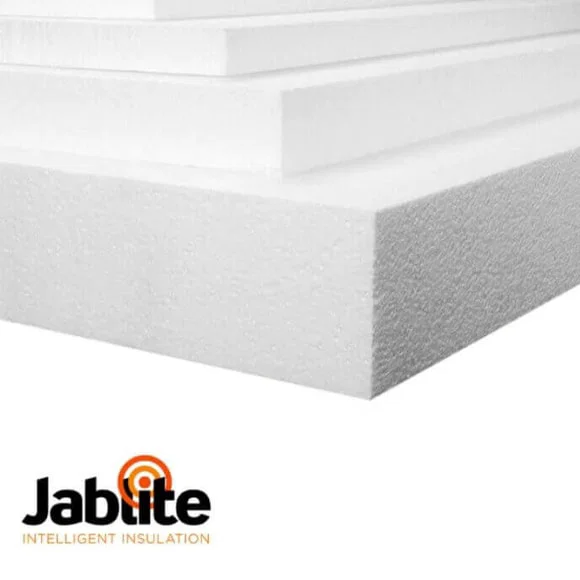
Compliance with Approved Document L: Thermal Efficiency
In the UK, the performance of insulation is primarily governed by Approved Document L (Part L) of the Building Regulations, which focuses on the conservation of fuel and power. This regulation mandates the use of materials that achieve specific levels of thermal performance to reduce energy demand and carbon emissions.
Jablite's low thermal conductivity characteristics make it a viable material for assisting builders in meeting, and potentially exceeding, the standards required by Part L. This focus on highly efficient building fabric is becoming more stringent, driven by initiatives such as the Future Homes Standard, which dictates significantly reduced energy demand targets for new dwellings. To meet these progressively strict requirements, meticulous attention must be paid to the overall system U-value, including detailed mitigation of thermal bridges.
Quality and Verification: BBA and NHBC
Due to the critical nature of insulation materials, independent third-party verification is essential. The British Board of Agrément (BBA) provides Agrément Certificates (e.g., Certificate 87/1796), which verify that Jablite products are fit for their intended use. This certification covers key performance factors including declared thermal conductivity, condensation risk, floor loading capability, and durability.
For construction projects covered by a warranty, the certification is a crucial assurance factor. The BBA has assessed Jablite products, such as Jabfloor 70 and 100 (including the HP and HP+ variants), as satisfying or contributing to satisfying the relevant requirements of NHBC Standards, specifically Chapters 5.1 (Substructure and ground bearing floors) and 5.2 (Suspended ground floors). The existence of this BBA certification, backed by regular surveillance and formal reviews, provides specifiers with confidence that the design intent for long-term compliance with durability and thermal performance requirements will be met, assuming correct installation.
Fire Safety Considerations: Approved Document B
Fire safety compliance is regulated by Approved Document B (Part B) of the Building Regulations. Jablite insulation is manufactured to meet specifications defined in BS EN 13163 and its reaction to fire is classified under the Euroclass system (BS EN 13501-1).
Standard EPS materials typically receive a Euroclass F rating, while those incorporating a flame-retardant additive are generally classified as Euroclass E. Euroclass E is the lowest classification level that requires any testing, involving exposure to a small flame for a limited duration. When fire-retarded EPS is exposed to ignition energy, it has the characteristic of shrinking away from the heat source and self-extinguishing once the heat source is removed.
Regulatory Restrictions on Combustible Materials
The fire classification of EPS imposes critical limitations, particularly in external wall applications. Current UK regulations restrict the use of combustible materials in and on the external walls of residential buildings with a storey 11 metres or more in height. For these structures, materials must achieve the highest reaction to fire classifications: Class A2-s1,d0 or A1. Since Jablite EPS typically achieves Euroclass E, its general use in the external walls of taller buildings is prohibited.
However, specific system applications, such as Jablite Full Fill Cavity Wall Insulation (Jabfill HP), have been certified by the BBA for use in external masonry cavity walls up to 25 metres in height. This certification explicitly states that
additional requirements apply for buildings above 12 metres in height. This highlights a complex regulatory environment: while Jablite is widely compliant and safe for internal, protected, and low-rise applications, its use in the external fabric of medium to high-rise construction demands rigorous adherence to bespoke fire engineering solutions, fire stopping, and cavity barrier protocols to satisfy Approved Document B requirements. Specifiers must differentiate carefully between internal and external envelope applications when considering the material’s fire performance.
Best Practice Installation and Detailing for Longevity
The durability and thermal effectiveness of Jablite insulation are intrinsically linked to the quality of the installation and the meticulous attention paid to detailing.
Preparation and Cutting Techniques
Jablite EPS is notable for its ease of handling; it is lightweight and clean, and no specialised personal protective equipment (PPE) is required for cutting. The boards can be easily cut to size on site using a sharp knife or a fine-toothed saw, allowing for a precise fit within the construction element. It is essential that all boards are tightly butted together during placement to ensure continuity of the thermal envelope.
Critical Moisture Management: Vapour Control Layers (VCLs)
Although EPS itself is moisture-resistant, managing water vapour within the structure is critical to prevent interstitial condensation, which occurs when warm, moist internal air meets colder elements within the structure. Condensation compromises thermal performance and can cause damage to other building components.
The requirement for vapour management is governed by BS 5250 (British Standard for Moisture Control in Buildings), which dictates that materials with the highest vapour resistance must be placed on the warm side of the insulation.
-
Floor Applications: When Jablite is installed over a concrete slab and beneath a liquid screed, a suitable membrane, such as a 125μ (500 gauge) polythene sheet, must be laid over the EPS. This VCL serves the dual purpose of managing vapour diffusion and preventing the wet screed from seeping into the insulation joints.
-
Airtightness: The VCL functions effectively only when it is continuous and airtight. All joints must be thoroughly lapped and sealed using specialised airtightness tapes. Punctures caused by follow-on trades, or failure to seal joints, can allow paths for water vapour to bypass the barrier, leading to critical failure of the condensation control strategy.
Mitigating Thermal Bridging (Cold Bridging)
Thermal bridges occur where there is a discontinuity in the insulation layer, resulting in localised heat loss that is significantly higher than through the main body of the wall or floor. These bridges severely compromise the overall thermal performance of the building, making it difficult to achieve compliant Part L U-values.
Two key detailing methods are mandated when installing Jablite to mitigate thermal bridging:
-
Floor Perimeters: In ground-bearing or suspended floor applications, a vertical upstand of EPS insulation must be installed continuously around the entire perimeter where the floor slab meets the external walls. This technique prevents a significant heat loss path at this junction.
-
Fixings: When securing the boards, metal fixings must be avoided, as metal is highly conductive and creates a thermal bridge across the insulation layer. Best practice requires the use of non-metallic, non-conductive fixing rods or anchors to maintain the integrity of the thermal envelope.
Chemical Protection and Service Integration
Jablite EPS is chemically inert under normal conditions, but it is susceptible to degradation from specific substances. EPS is soluble in aromatic, halogenated solvents, and ketones, and must therefore be shielded from contact with hydrocarbons and strong solvents using an appropriate protective membrane.
A particularly important consideration on site is the interaction with electrical cables. EPS should never be permitted to come into direct contact with PVC-sheathed electrical cables. The plasticiser within the PVC can migrate into the EPS, leading to the chemical degradation of the insulation and subsequent embrittlement of the cable sheath. To prevent this, cables must be physically protected, typically by enclosing them in a conduit or ensuring an adequate air gap is maintained.
The table below provides a checklist of essential detailing requirements for Jablite installation:
Best Practice Checklist for Installation and Detailing
| Application Area | Critical Detailing Requirement | Compliance/Performance Rationale |
| Ground Floors (Over Slab) | Install a continuous 125μ (500 gauge) VCL over the EPS boards. | Manages water vapour diffusion and prevents screed penetration into the insulation joints |
| All Applications | Ensure the VCL is placed entirely on the warm side of the insulation. | Prevents high risk of interstitial condensation in accordance with BS 5250. |
| All VCL Joints | Joints and laps must be meticulously sealed using specialised airtightness tape. | Essential for forming a continuous, functional airtight barrier. |
| Floor-to-Wall Junctions | Install a continuous perimeter upstand of EPS insulation. | Mitigates severe cold bridging, necessary for satisfying Part L targets. |
| Fixing Methods | Use non-metallic (plastic) fixing rods or non-conductive anchors. | Prevents conductive heat loss through the insulation layer. |
| Cable Protection | Protect PVC-sheathed electrical cables from direct contact with EPS boards. | Prevents chemical degradation of both the cable sheath and the EPS material. |
Environmental Profile and Sustainability Credentials
Jablite EPS demonstrates a robust environmental profile, which is increasingly important for sustainable construction in the UK. The product achieves an A+ rating in the Building Research Establishment (BRE) Green Guide to Specification, placing it among the materials with the highest environmental performance in certain application classes.
The material’s composition contributes positively to sustainability objectives. Jablite is non-toxic, biologically inert, and will not promote mould growth or attract vermin. From a material life-cycle perspective, Jablite EPS is 100% recyclable, assisting builders in meeting construction waste reduction goals.
Furthermore, Jablite HP insulation is manufactured with zero Ozone Depletion Potential (ODP) and a low Global Warming Potential (GWP) of less than 5. These characteristics confirm that the material selection supports responsible environmental practices without contributing to ozone depletion.
Conclusions and Summary Recommendations
Jablite insulation offers a versatile, durable, and cost-effective Expanded Polystyrene solution that is highly suited to the thermal demands of contemporary UK construction. Its core technical strengths lie in its consistently low thermal conductivity, high compressive strength across a range of applications (EPS 70 up to EPS 500), and proven longevity equivalent to the structure’s intended life.
For successful specification and long-term compliance with UK Building Regulations, specifiers must exercise careful diligence beyond simply selecting the required U-value. The effectiveness of the insulation system is conditional upon three critical factors:
-
Correct Grade Selection: Matching the specific EPS grade (e.g., EPS 70 for domestic, EPS 100+ for commercial) to the projected structural load is essential to prevent material creep and maintain system stability over decades.
-
Thermal Continuity: Meticulous detailing to mitigate cold bridging, especially through the implementation of perimeter upstands and the mandatory use of non-conductive fixings, is required to prevent the installed U-value from being significantly worse than the designed U-value.
-
Moisture Management: Strict adherence to Vapour Control Layer protocols, including placing the barrier on the warm side of the insulation and ensuring all joints and penetrations are sealed and protected, is necessary to prevent interstitial condensation and preserve the material’s long-term effectiveness, as verified by BBA certification.
While Jablite is a foundational material for energy efficiency (Part L), its standard fire classification (Euroclass E) necessitates rigorous review of Approved Document B, especially regarding external wall applications above 11 metres in height.
UK Legal Disclaimer
This report has been prepared for informational and educational purposes only. The technical details provided are derived from general industry information and relevant UK standards (such as BS EN 13163, Approved Document L, and Approved Document B). This content does not constitute professional advice, design specification, or a guarantee of suitability for any particular project. Building Regulations, fire safety legislation, and associated guidance (including BBA certification and NHBC Standards) are subject to frequent change. All users, especially professional specifiers, contractors, and architects, must consult the most current version of the Building Regulations applicable to their jurisdiction and project type, and obtain independent advice from a qualified construction professional, structural engineer, or fire engineer before selecting, installing, or specifying any construction material, including Jablite insulation products. The user assumes all responsibility for verifying the compliance and safety of materials and systems as installed.

Samuel Hitch
Managing Director
Buy Insulation Online.
Leave A Reply
Your feedback is greatly appreciated, please comment on our content below. Your email address will not be published. Required fields are marked *