
- Blogs
- How to Specify Insulation in 2026
How to Specify Insulation in 2026


Introduction
The UK insulation market in 2026 is being shaped by three pressures at once: tighter energy regulation, stricter fire safety controls, and sharp material price volatility. Approved Document L 2021 remains the current regulatory baseline for most projects in England, but the Future Homes Standard now has a confirmed commencement date of 24 March 2027, followed by a 12-month transition period ending on 24 March 2028 for standard building work.
That transition matters commercially because schemes can continue under the earlier regime only if building-control documents are submitted before the cut-off and meaningful work starts in time. At the same time, post-Grenfell fire requirements continue to narrow the practical product choices for external walls, especially above 11 metres and above 18 metres, so thermal performance can no longer be considered in isolation.
Future Homes Standard
Timing and transition
The Future Homes Standard takes effect on 24 March 2027 for standard building work in England. The main transition period ends on 24 March 2028 — projects that miss that deadline must move onto the new regime. This is especially important for phased developments because transitional protection is no longer treated as a blanket site-wide concession.
From SAP to HEM
The move from the Standard Assessment Procedure toward the Home Energy Model is not simply a software update. HEM models dwelling performance in a more dynamic and time-sensitive way, with stronger treatment of solar gains, heat losses, and the interaction between fabric and heating systems. During the transition, SAP 10.3 remains relevant while the HEM infrastructure is phased in.
U-values, airtightness and performance targets
The most useful framing for 2026 is to separate notional design targets from absolute backstop limits. For FHS-ready detailing, the notional airtightness target is 3.0 m³/h/m² with a tightened backstop of 4.0 m³/h/m² — the previously common 8.0 m³/h/m² figure is no longer appropriate for forward-looking specifications.
Table 1: U-value and airtightness targets — Part L 2021 vs Future Homes Standard 2026
Source: Approved Document L 2021 & Future Homes Standard statutory guidance (gov.uk)
Zero-carbon-ready homes
The Future Homes Standard requires new homes to be designed around low-carbon heating and on-site generation rather than fossil-fuel gas boilers. Heat pumps, solar PV, stronger fabric performance, and tighter airtightness are the default package. Homes built to this standard are designated "zero-carbon ready" — their operational carbon footprint will reduce naturally as the UK electricity grid decarbonises.
Fire Safety and Façade Rules
Over 18 metres
For relevant buildings above 18 metres, EPS, XPS, PIR, and phenolic foam should all be treated as unsuitable in the external wall system unless a very specific and lawful exception applies. Mineral wool (Euroclass A1) and other A1 or A2-s1,d0 products are the only practical compliant route under the Building Safety Act 2022 and Approved Document B.
Between 11 and 18 metres
Combustible façade materials in this range may rely on system-level fire testing (BS 8414-1 or BS 8414-2 with BR 135 criteria), build-up-specific evidence, surface-spread controls, and project-specific justification — not any simple board-level classification claim. Phenolic foam should not be described as a straightforward compliant option for 11–18 metre buildings.
Phenolic foam: the correct fire classification
Products such as Kingspan Kooltherm K5 achieve a Euroclass rating of C-s2,d0 — not Euroclass A1 or A2. Under EN 13501-1, Class C means combustible. This distinction should not be obscured by shorthand marketing wording, particularly in specifications for taller buildings.
2026 second staircase requirement
From 30 September 2026, new residential buildings over 18 metres in England must include a second staircase. This increases façade complexity and the number of junctions where fire integrity and thermal continuity must both be maintained. Secure Information Boxes are required on all buildings over 11m, and Evacuation Alert Systems on all buildings over 18m.
Insulation Materials: What to Specify in 2026
Glass fibre and glass mineral wool
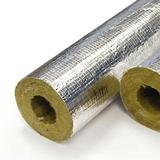
Standard glass mineral wool achieves Euroclass A1 — non-combustible under BS EN 13501-1, the same classification as stone mineral wool, meaning it carries no building height restrictions for most applications. The practical limitation in walls is physical rather than fire-related: its lower density makes it less suitable for high-performance acoustic applications. Current pricing: £3.50–£5.50/m².
Rock / stone mineral wool (Rockwool / Knauf Earthwool)
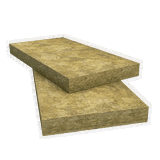
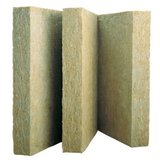
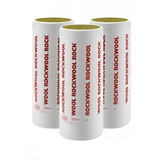
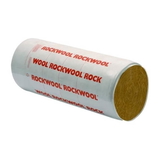
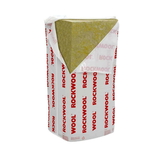
Rock mineral wool achieves Euroclass A1 non-combustible and is the default choice wherever fire safety and acoustic performance both matter. It is the only straightforward route above 18 metres and the lowest-risk specification for 11–18 metre external walls. Current pricing: £7.00–£11.00/m².
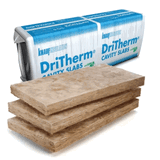
Note on Dri-Therm 37: This product will not meet the FHS 0.15 W/m²K wall target in a standard 100mm cavity. Designers are now specifying wider cavities (typically 150mm) filled with Dri-Therm 32 (λ 0.032 W/mK) or Dri-Therm 34 as the compliant route.
Sheep's wool
Sheep's wool is particularly suited to breathable wall constructions in timber-frame buildings. Pricing has risen modestly to £20.00–£36.00/m² with supply remaining broadly stable.
Expanded Polystyrene (EPS)
EPS has seen significant price increases in 2026, with current pricing at £10.00–£13.00/m². Standard EPS achieves Euroclass E (combustible) and cannot be used in external wall systems on buildings over 18m. It is restricted on 11–18m buildings under the Building Safety Act 2022.
Extruded Polystyrene (XPS)
XPS has proved the most price-stable rigid board in 2026, with current pricing at £5.00–£9.00/m². It is the preferred choice for below-ground and sub-slab applications where moisture resistance is critical. It shares the same Euroclass E fire restrictions as EPS in standard form.
PIR foam boards (Celotex, Kingspan, IKO, Recticel)
PIR boards offer lambda values of 0.022–0.023 W/mK and are highly effective for floors and roofs where thickness is constrained. They cannot be used in external wall systems on buildings over 18m.
Supply alert (May 2026): Celotex has placed all PIR boards on allocation with a 15% price increase. Kingspan PIR has seen a 7.5% increase. Current pricing: £15.00–£35.00/m². Order early and confirm lead times.
Phenolic foam (Kingspan Kooltherm, Ecotherm)
Phenolic foam offers the highest thermal performance of any common rigid board (λ ~0.021 W/mK) but is combustible (Euroclass C-s2,d0). It has a valid role in floors, roofs, low-rise build-ups, and pipe/duct insulation. Current pricing: £25.00–£35.00/m² following a 4–7.5% increase in 2026.
Aerogel (Spacetherm, Proctor)
Aerogel offers lambda values of ~0.015 W/mK — approximately three times better than PIR per millimetre. Spacetherm A1 achieves Euroclass A1 non-combustible with no building height restrictions. Expensive at £77.00–£97.00/m² and best reserved for heritage retrofit and space-constrained applications.
Reflective multifoils and hybrid systems
Modern hybrid products such as Actis Hybris are BBA-certified (Certificate No. 24/7263) with a declared λD of 0.033 W/mK. They should be specified on the basis of certificate-backed build-up performance and have a practical application in sloping roofs and space-constrained retrofits.
Pricing: Q2 2026 Market Conditions
Geopolitical instability and energy cost pressures in early 2026 triggered significant price increases across most insulation categories. The inflation chart below shows only manufacturer-announced percentage increases from formal supplier bulletins — no range-midpoint calculations. XPS remains the most price-stable rigid board. PIR has seen the most significant shift in both price and availability.
Table 2: Insulation material pricing 2025 vs May 2026 (ex-VAT, materials only)
Source: Buy Insulation Online procurement data & supplier bulletins May 2026
Chart 1: Manufacturer-announced price increases Q2 2026 — Celotex, Kingspan, Knauf, BEWI, Sundolitt
All percentages are formally announced figures. Whiskers show the announced range where applicable.
The commercial takeaway is clear: PIR is now both a thermal and a procurement-risk decision. Rock mineral wool has seen more modest inflation and stable availability, strengthening its position as the practical default for walls, façades, and acoustic packages. XPS's relative price stability makes it increasingly attractive where moisture resistance is the primary driver.
Buy Insulation
Moisture, Airtightness and Condensation
Vapour control and interstitial condensation
As homes are sealed to meet FHS airtightness targets, passive ventilation through draughts disappears. A continuous Vapour Control Layer (VCL) on the warm side of the insulation is essential. PIR boards with foil facings act as a VCL when all joints are fully taped with approved foil tape. Breathable natural insulants such as sheep's wool and wood fibre can buffer moisture vapour hygroscopically, making them well suited to heritage retrofit.
Loft eaves detailing
Best practice requires fitting rigid rafter trays or ventilation baffles first, preserving a continuous 50mm air gap before laying insulation. Failing to do this creates trapped moisture pockets and aggressive mould growth on roof timbers.
Awaab's Law
The expansion of Awaab's Law in 2026 extends duties to cover excess cold, excess heat, and structural hazards alongside damp and mould. Specifying inadequate insulation that leaves a property susceptible to excess cold now carries immediate regulatory and litigation risk for landlords and housing associations.
How the Changes Affect Residential vs Commercial Construction
Residential new build
The Future Homes Standard is residential-specific. From 24 March 2027, every new home in England must be designed as zero-carbon ready:
- No gas boilers — heating must be provided by heat pumps or district heat networks
- Mandatory solar PV — on-site renewable electricity generation is a new functional requirement
- Tighter fabric targets — walls 0.15 W/m²K, roofs 0.11 W/m²K, floors 0.11 W/m²K, with tested airtightness at practical completion
- SAP to HEM transition — SAP 10.3 is the interim tool while HEM is phased in
- Whole-building compliance — individual elemental U-values alone are no longer sufficient
The 12-month transitional window closes 24 March 2028. The distinction between site-wide and individual building commencement is commercially important for phased developments.
Commercial new build
Commercial buildings fall under the Future Buildings Standard with SBEM as the compliance engine. The more immediate pressure in 2026 is fire safety under Approved Document B:
- Buildings over 18m must use A1 or A2-s1,d0 non-combustible insulation in external wall systems regardless of use class
- The second staircase requirement from 30 September 2026 applies to all new residential blocks of flats over 18m
- Secure Information Boxes (11m+) and Evacuation Alert Systems (18m+) are now mandatory
Side-by-side comparison
|
|
Residential |
Commercial |
|
Primary regulatory driver |
Future Homes Standard |
Future Buildings Standard + Approved Doc B |
|
Compliance engine |
SAP 10.3 / HEM |
SBEM |
|
Gas boiler ban |
Yes — from March 2027 |
Effectively yes |
|
Mandatory renewables |
Yes — solar PV required |
No universal mandate |
|
Airtightness testing |
Mandatory at completion |
Required, different targets |
|
External wall fire rules 18m+ |
A1/A2-s1,d0 only |
A1/A2-s1,d0 only |
|
Second staircase |
Residential blocks over 18m |
Not applicable to non-residential |
|
Retrofit funding |
ECO4 / Warm Homes Plan |
Not eligible |
Retrofit Funding: The Transition to the Warm Homes Plan
ECO4 has been extended to 31 December 2026, while the Great British Insulation Scheme (GBIS) ended permanently on 31 March 2026. Replacing both is the Warm Homes Plan, a £15 billion government commitment through 2030, targeting upgrades to up to five million properties. BBA-certified and TrustMark-compliant products are increasingly required to access grant-funded work.
Cold Bridging
Under Part L 2021, Psi-values (linear thermal transmittance) for all junction details must be formally calculated and submitted as part of the SAP assessment for every new dwelling. The Accredited Construction Details (ACDs) provide pre-approved junction specifications. In FHS-targeted designs, cold bridging is frequently the dominant remaining heat loss pathway once fabric U-values are controlled.
Model House: Insulation Costs (May 2026)
The table below uses a standard new-build — 80m² ground floor, 200m² external walls, 80m² ceiling/roof, 60m² acoustic walls, 75m² acoustic floors — with specifications targeting FHS 2026 notional values and updated to May 2026 verified pricing.
Table 3: Model house insulation costs — May 2026 pricing using verified procurement data
Source: Buy Insulation Online | Labour ~£200/day
The total including ground floor is now approximately £11,000, reflecting both tighter FHS specification requirements and Q2 2026 supply-chain inflation. As a proportion of build cost, insulation typically remains around 5–6% of total construction costs. Note: Ground floor insulation is typically included within the groundworks budget.
Where to Buy
Buy Insulation Online (buyinsulationonline.co.uk) stocks an extensive range of mineral wool, PIR, EPS, acoustic wool, membranes, airtightness tapes, and ancillaries from certified manufacturers. Given current PIR allocation issues, early procurement is strongly advised for any project with rigid board requirements. SIG, Encon, Insulation Superstore, and Insulation 4 Less are alternative national distributors.
Material Suitability Matrix
The two matrices below are a plain-language quick-reference for specifiers. Each cell states either the approximate thickness required to hit the FHS 2026 target, the specific reason a material is conditional, or that it is prohibited or not available in that product form. Full U-value calculations incorporating thermal bridging are always required — thicknesses shown are indicative for the material lambda only.
Vacuum Insulated Panels (VIPs) are included in both matrices. They achieve a whole-panel effective lambda of approximately 0.006–0.008 W/mK — roughly five times better per millimetre than PIR. However, they cannot be cut on site, must be ordered to exact dimensions, are permanently destroyed by puncture, are not Euroclass A1, and are not suitable for below-ground or ground floor applications due to fragility under load and vacuum degradation on contact with sustained ground moisture.
Matrix A: Thermal Performance Applications
Matrix A: Loft, cavity wall, ground floor, sloped roof, pipe/duct — FHS 2026 U-value targets
Green = suitable (indicative thickness) | Amber = one specific condition applies | Red = prohibited or not available in this product form
Source: Buy Insulation Online | Approved Document L 2026 | All thicknesses indicative only
Matrix B: Fire Compliance and Specialist Applications
Matrix B: External walls by height, below-ground, acoustic walls — Approved Document B 2026
Green = Euroclass A1/A2 — no restriction | Amber = BS 8414 full system test required | Red = prohibited or not available in this product form
Source: Buy Insulation Online | Approved Document B (Dec 2022 amendments) | Building Safety Act 2022
Technical Notes and Corrections Applied
- Glass Mineral Wool — Pipe/Duct (corrected to Green): Available as standard pipe sections and duct wrap. Suitable for HVAC pipework, boiler flue insulation, and ductwork applications.
- PIR Boards — Pipe/Duct (corrected to Amber): PIR is available as flat duct slab only. It is not manufactured as pipe sections. For pipe insulation, use mineral wool pipe sections, phenolic pipe sections, or aerogel pipe wrap.
- VIPs — Ground Floor (corrected to Red): Fragile under the compressive load of a floor build-up. Not a standard under-slab product. The rigid panel construction cannot reliably sustain the point loads imposed during screed laying or occupancy. Use PIR, EPS, or XPS for ground floors.
- VIPs — Cavity Wall <11m (Green, 20–30mm): The thinnest cavity wall option available. Achieves FHS 0.15 W/m²K at 20–30mm versus 150mm for Dri-Therm 32. Requires specialist installation and factory pre-cutting.
- VIPs — Sloped Roof (Green, 20–25mm): Order to exact rafter bay dimensions. Allow 6–8 week lead time. Damaged panels must be replaced in full.
- VIPs — Pipe/Duct (Red): Adhesive seal degrades above approximately 70–100°C. Not suitable for pipework near heat sources.
- VIPs — Ext. Wall 11–18m (Amber): Not Euroclass A1. Full BS 8414-1 or BS 8414-2 system fire test required.
- VIPs — Ext. Wall >18m (Red): Prohibited under Regulation 7(2). Not Euroclass A1.
- VIPs — Below Ground (Red): Sustained moisture contact degrades the vacuum via barrier film permeation. No visible sign of failure from the outside. Use XPS below DPC.
- VIPs — Pricing: Typically £150–£300/m². Justified only where every millimetre counts — heritage reveals, listed building retrofits, or slimline floor finishes where a screed height is fixed.

Samuel Hitch
Managing Director
Buy Insulation Online.
Leave A Reply
Your feedback is greatly appreciated, please comment on our content below. Your email address will not be published. Required fields are marked *